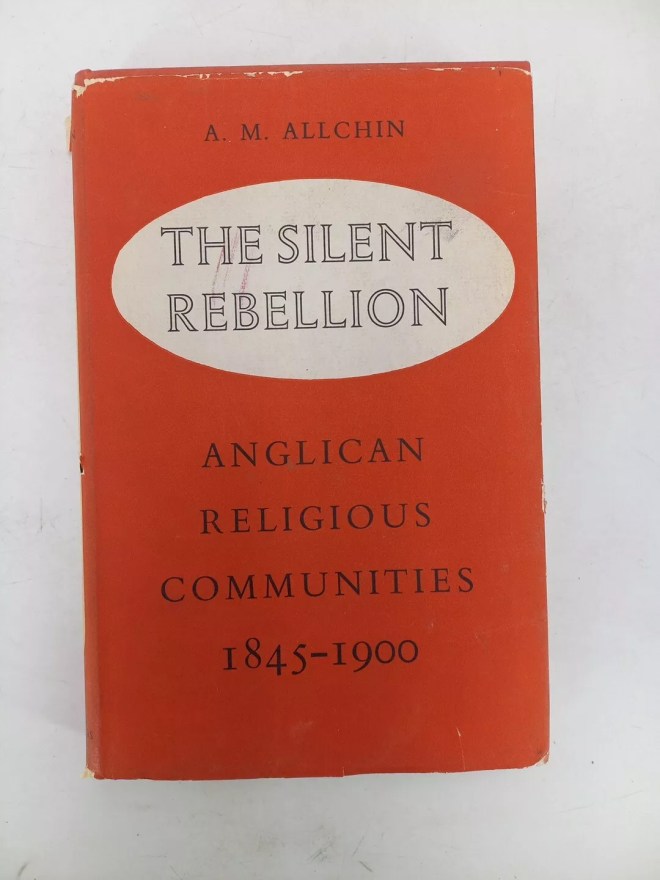
One of the first books on the revival of religious life within the Anglican Communion is titled, The Silent Rebellion: Anglican Religious Communities 1845 – 1900.
In the Preface, Allchin states:
The technical meaning of the word ‘religious’ presents some difficulties in a work of this type. For one thing, the terms ‘monk’, ‘monasticism’, etc., were used indiscriminately from the time of the Reformation until the middle of the nineteenth century or later, to describe all types of religious community. In recent times it has been usual among careful writers to confine the words ‘monk’ and ‘nun’ to religious who belong to contemplative communities or follow some form of the rule of St Benedict. But a further problem arises about the word ‘religious’ itself, especially in connexion with the question of vows. According to the Directory of the Religious Life issued by the Advisory Council on Religious Communities, with the authority of the Archbishops of Canterbury and York, the religious state is described as ‘one of voluntary and complete self-consecration to God’, ‘attained by the voluntary undertaking of certain obligations sealed by Vows, Perpetual or Temporary’ (op. cit., 2nd ed., 1957, pp. 1 and 7). The forms which religious communities may take are many, ranging from the purely contemplative to those actively engaged in works such as preaching, teaching or nursing. And, as the Archbishops state in their
Commendation of the Directory, ‘the vocation to the service of God in Communities under the threefold Vows of Poverty, Chastity, and Obedience is an energy of the Holy Spirit which a Directory of this kind can never properly describe.’ It is interesting to notice that the Directory itself includes within its scope on the one hand Solitaries who have received ‘the rare and difficult vocation of living the Contemplative Life in solitude’, and on the other hand communities whose members express a life intention of stability, but are not under the obligation of vows. An examination of the early history of Christian monasticism, and indeed of the theological aspects of the question, suggests that although vows form the usual expression and safeguard of this form of life, in themselves ‘they do not constitute the religious life’, which is rather ‘the life of the Spirit within the heart of those who take the vows’. (For a fuller discussion of this point see below, pp. 74-77 and p. 187.) In other words, the life is founded in the Word of God, and not in the words of men. It is brought into being by certain words of the Gospel which all Christians have to face, and which some are called to accept in a particularly literal way. The story of St Antony the Great, who went to church one Sunday and hearing the Gospel read ‘If thou wilt be perfect, go and sell that thou hast and give to the poor, and thou shalt have treasure in heaven; and come and follow me’ (Matt. 19.21), took God at his word, is in this sense typical and original of every religious vocation. All the subsequent developments of Christian monasticism come from this one single root.
There is a sense that the above describes the difference between an Eastern understanding, that we may call Monastic Life, and a Western understanding, that maybe called Religious Life. I think it is a good place to start when thinking about what it means when Jesus says, “if any man will come after me, let him deny himself, and take up his cross, and follow me” (Matthew 16:24).