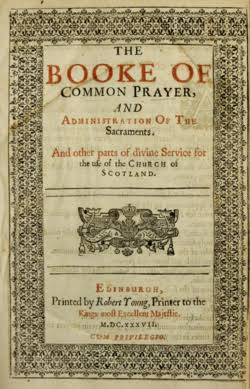
1549 baptism

Then shall the priest demaunde of the childe (which shalbe first Baptized) these questions blowing: first naming the childe, and saying.

N. Doest thou forsake the devill and all his workes?
Aunswere. I forsake them.
Minister. Doest thou forsake the vaine pompe, and glory of the worlde, with all the covetouse desyres of the same?
Aunswere. I forsake them.
Minister. Doest thou forsake the carnall desyres of the flesh, so that thou wilt not folowe, nor be ledde by them?
Aunswere. I forsake them.
baptism and Romans 14

… Let not him that eateth despise him that eateth not; and let not him which eateth not judge him that eateth: for God hath received him. Who art thou that judgest another man’s servant? to his own master he standeth or falleth. Yea, he shall be holden up: for God is able to make him stand. One man esteemeth one day above another: another esteemeth every day alike. Let every man be fully persuaded in his own mind. … But why dost thou judge thy brother? or why dost thou set at nought thy brother? for we shall all stand before the judgment seat of Christ. … So then every one of us shall give account of himself to God. … Hast thou faith? have it to thyself before God. Happy is he that condemneth not himself in that thing which he alloweth.

Mattins (Wednesday after Trinity 14) Reading: Romans 14

and …

Dost thou renounce the devil and all his works, the vain pomp and glory of the world, with all covetous desires of the same, and the carnal desires of the flesh, so that thou wilt not follow nor be led by them?

Public Baptism of such as are of Riper Years

prayer and fasting

Council of Chalcedon
Canon IV.

Let those who truly and sincerely lead the monastic life be counted worthy of becoming honour; but, forasmuch as certain persons using the pretext of monasticism bring confusion both upon the churches and into political affairs by going about promiscuously in the cities, and at the same time seeking to establish Monasteries for themselves; it is decreed that no one anywhere build or found a monastery or oratory contrary to the will of the bishop of the city; and that the monks in every city and district shall be subject to the bishop, and embrace a quiet course of life, and give themselves only to fasting and prayer, remaining permanently in the places in which they were set apart; and they shall meddle neither in ecclesiastical nor in secular affairs, nor leave their own monasteries to take part in such; unless, indeed, they should at any time through urgent necessity be appointed thereto by the bishop of the city. And no slave shall be received into any monastery to become a monk against the will of his master. And if any one shall transgress this our judgment, we have decreed that he shall be excommunicated, that the name of God be not blasphemed. But the bishop of the city must make the needful provision for the monasteries.

Henry R. Percival. The Seven Ecumenical Councils of the Undivided Church: their Canons and Dogmatic Decrees

BCP and fasting?

I asked this on FB so …

For those in the know (you know who you are): with the revision of the Prayer Book, what is the canonical standing of the “Tables and Rules for the Feasts and Fasts through the whole Year”?

Is an Anglican to keep these fasts?

There is an ascetic system enshrined in BCP (1662) – a discipleship way. But I have never heard anyone speak of it?

The Religious Societies of the seventeenth century offer most practical and important witness. Associated with Anthony Horneck’s ministry at the Savoy Chapel, London, and later with William Beveridge and Robert Nelson, these societies arose as an attempt – and a successful one – to practise the full teaching of the Church as enshrined in the Book of Common Prayer. The initial influence of these societies, these “Faithful Remnants”, was enormous, and history supports their sanity and zeal. The recitation of the daily Office was central to their activity, a priest-director was an essential part of the system, while works of charity towards the poor were a natural outcome. It is significant that their demise came when extraneous interests in politics and sociology overbalance the original Godward intention. For most of our modern parochial organizations, the writing on the wall could hardly be plainer.

English Spirituality

what has happened …

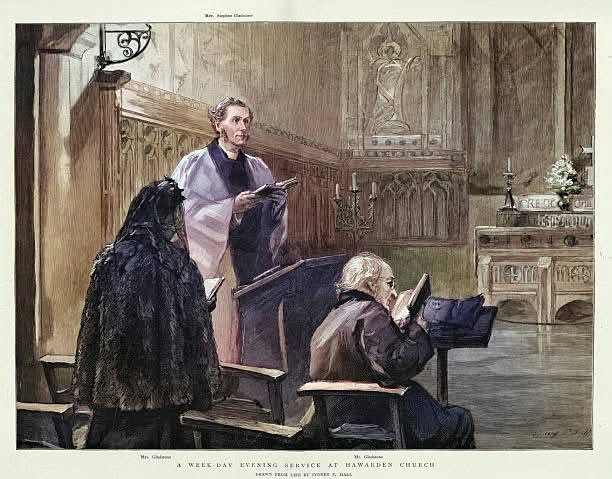
William Ewart Gladstone and his wife, at Mass, Anglican vicar, Hawarden Church, Vintage illustration 1890s, 19th Century

What happened to Mattins and Evensong? I am meeting Anglicans who have never attended either service. Or, who have only attended the modern version (euphemistically called Morning Prayer with little connection to the traditional shape). The modern church (oh, how I hate that term) is so quick to jump to “saying Mass” with traditional prayer services being an afterthought.

And what happened to “priest and people” together praying? Active participation means we have laypeople doing clergy jobs, and clergy dominating laypeople in their vocation.

And what has happened to fasting?

Companion of New Skete

I am not a joiner! I did not join the “normal Anglo-Catholic” societies when I was a priest, nor any religious order as an oblate etc. But ….

It is intrinsic to ascetical theology to adapt itself to the contemporary situation, yet it can only evolve out of a living tradition with roots in the past.

English Spirituality, 13

I have been accepted as a Companion of the New Skete. And I am super excited. A connection to a living tradition while I remain within my own tradition. The beginning of a Prayer Book Ascetic.

monkerie

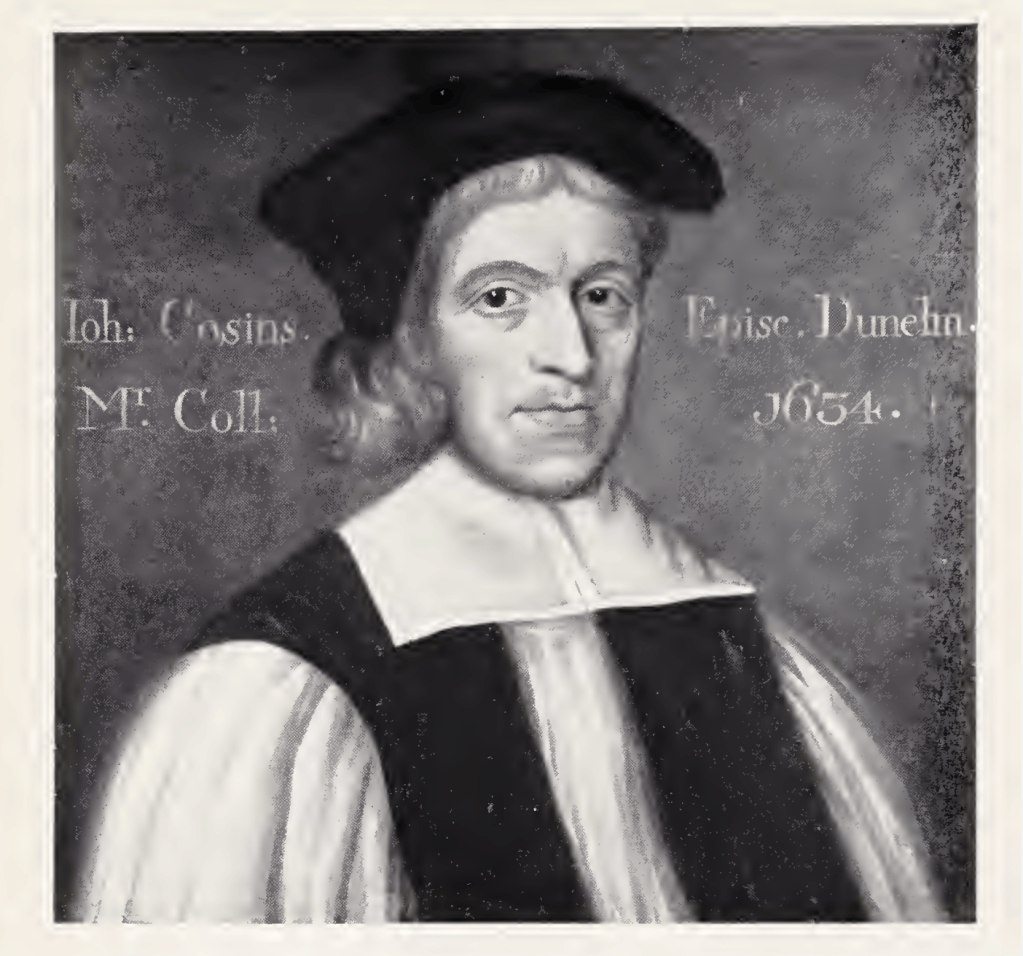
Cosin’s Primer, on the other hand, appearing unexpectedly and subversively in ‘our aged and noontide seasons of the Gospel’, was no less than a step on the way back to Popery, the provision for the observance of the canonical hours importing nothing else ‘but a necessitie of bringing in Monkerie and so of erecting cells again’

Introduction in JOHN COSIN, A Collection of Private “Devotions”

“Faithful Remnants”

The Religious Societies of the seventeenth century offer most practical and important witness. Associated with Anthony Horneck’s ministry at the Savoy Chapel, London, and later with William Beveridge and Robert Nelson, these societies arose as an attempt – and a successful one – to practise the full teaching of the Church as enshrined in the Book of Common Prayer. The initial influence of these societies, these “Faithful Remnants”, was enormous, and history supports their sanity and zeal. The recitation of the daily Office was central to their activity, a priest-director was an essential part of the system, while works of charity towards the poor were a natural outcome. It is significant that their demise came when extraneous interests in politics and sociology overbalance the original Godward intention. For most of our modern parochial organizations, the writing on the wall could hardly be plainer.

English Spirituality, 266