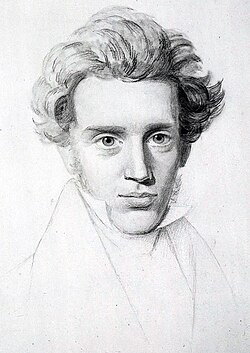
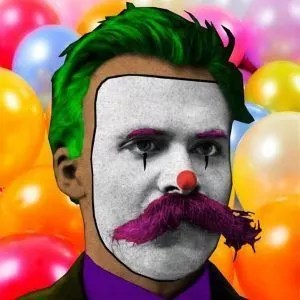
the mad clown!?

The madman.- Have you not heard of that madman who lit a lantern in the bright morning hours, ran to the market place. and cried incessantly: “I seek God! I seek God!” – As many of those who did not believe in God were standing around just then, he provoked much laughter. Has he got lost? asked one. Did he lose his way like a child? asked another. Or is he hiding? Is he afraid of us? Has he gone on a voyage? emigrated? – Thus they yelled and laughed.

Nietzsche (Joyous Science, 125)

A fire broke out backstage in a theatre. The clown came out to warn the public; they thought it was a joke and applauded. He repeated it; the acclaim was even greater. I think that’s just how the world will come to an end: to general applause from wits who believe it’s a joke.

Soren Kierkegaard, Either/Or, Part I
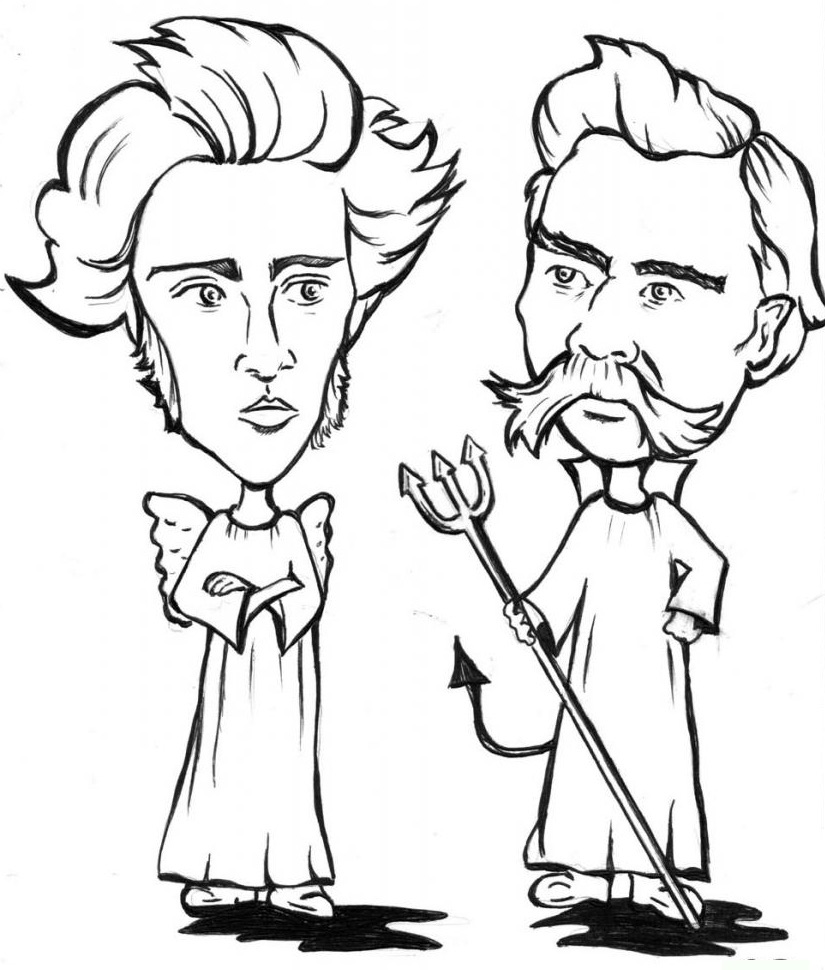
argument for seriousness

Further to the last post:

The reader should not mistake this for a conservative lament. Kierkegaard does not praise the past. He does not claim that earlier generations were noble or that older institutions were pure. His concern is simpler and more demanding. He asks whether the individual can recover a sense of interior responsibility that does not depend on the approval or the attention of the age. He urges the reader to confront the truth that each person must begin by governing himself before he imagines that he can contribute to the governance of the world. This is not an argument for withdrawal. It is an argument for seriousness.

Translator’s Preface (S.R. Travers) in The Present Age: On the Death of Rebellion

I want honesty

Very simply—I want honesty. I am not, as some well-intentioned people … have wanted to represent me, I am not Christian stringency in contrast to a given Christian leniency.

Certainly not, I am neither leniency nor stringency—I am human honesty.

I want to have the mitigation that is the current Christianity here in this country set alongside the New Testament in order to see how these two relate to each other.

If it proves to be so, if I or anyone else can show that it can be maintained face to face with the Christianity of the New Testament, then I will accept it with the greatest joy.

But one thing I do not want at any price: I do not want to create, by suppression or artifice, the appearance that the current Christianity in this country and the Christianity of the New Testament resemble each other.

The Moment and Late Writings

being “incognito”

The individual does not stop being a human being, take off finitude’s motley in order to be dressed in the abstract garb of the monastery; but nor does he mediate between the absolute τέλος and finitude. In immediacy the individual is rooted in the finite; when resignation has convinced itself that he has acquired the absolute orientation towards the absolute τέλος, all is changed, the roots severed. He still lives in the finite, but he does not have his life in it. His life, just like anyone else’s, has the diverse predicates of a human existence, but he inhabits them as one who goes around in clothes borrowed from a stranger. He is a stranger in the world of the finite, but does not define his difference from worldliness by an alien mode of dress (a contradiction, since it would define him as worldly); he is incognito, but his incognito consists precisely in looking just like everyone else.

Kierkegaard: Concluding Unscientific Postscript (Cambridge Texts in the History of Philosophy), 344-345

leveling

A particular individual can take the lead in an insurrection, but no particular individual can take the lead in leveling, for then he would, after all, become the commander and escape the leveling. Particular individuals may contribute to leveling, each in his own little group, but leveling is an abstract power and is abstraction’s victory over individuals. In modern times leveling is reflection’s correlative to fate in antiquity. The dialectic of antiquity was oriented to the eminent (the great individual—and then the crowd; one free man, and then the slaves); at present the dialectic of Christianity is oriented to representation (the majority perceive themselves in the representative and are liberated by the awareness that he is representing them in a kind of self-consciousness). The dialectic of the present age is oriented to equality, and its most logical implementation, albeit abortive, is leveling, the negative unity of the negative mutual reciprocity of individuals.

Kierkegaard’s Writings, XIV, Volume 14: Two Ages, 84

the core of the issue

Kierkegaard describes the core of the modern world in one sentence:

In Hegelian philosophy the outer (the externalization) is higher than the inner.

Evans, C. Stephen; Walsh, Sylvia. Kierkegaard: Fear and Trembling (Cambridge Texts in the History of Philosophy)

No institution can give you the answer to a personal problem. No outside can give you meaning!