the mad clown!?

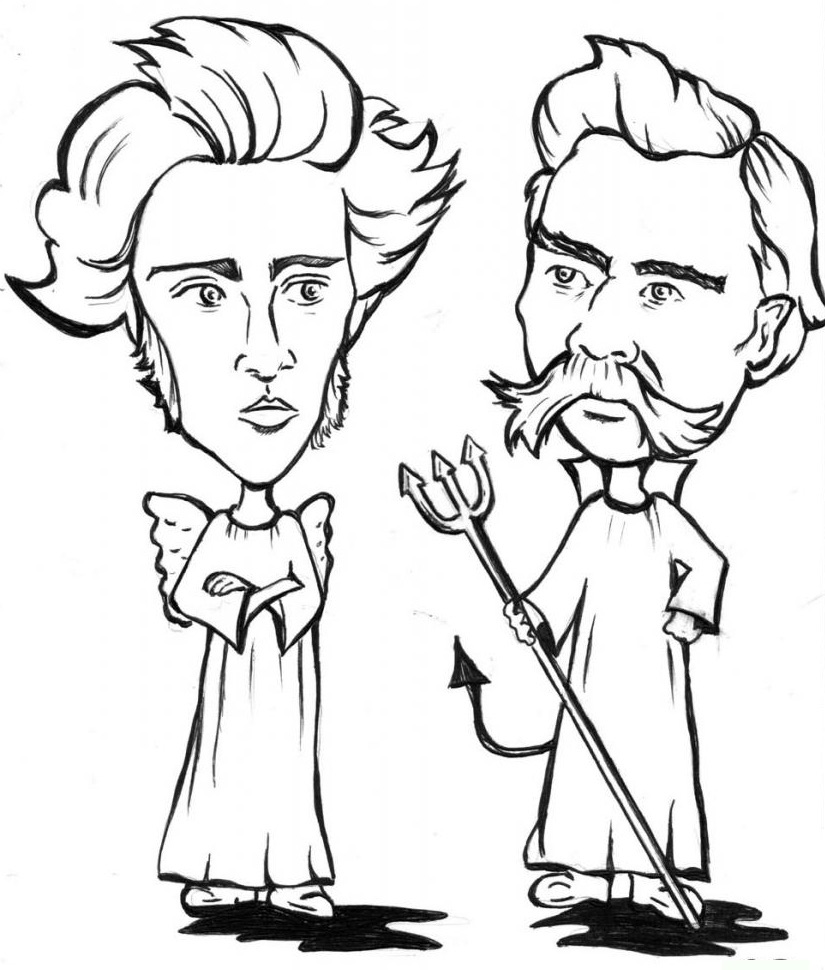
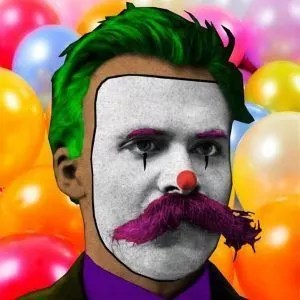
The madman.- Have you not heard of that madman who lit a lantern in the bright morning hours, ran to the market place. and cried incessantly: “I seek God! I seek God!” – As many of those who did not believe in God were standing around just then, he provoked much laughter. Has he got lost? asked one. Did he lose his way like a child? asked another. Or is he hiding? Is he afraid of us? Has he gone on a voyage? emigrated? – Thus they yelled and laughed.

Nietzsche (Joyous Science, 125)

A fire broke out backstage in a theatre. The clown came out to warn the public; they thought it was a joke and applauded. He repeated it; the acclaim was even greater. I think that’s just how the world will come to an end: to general applause from wits who believe it’s a joke.

Soren Kierkegaard, Either/Or, Part I

the needful sacrifice

The Needful Sacrifice.—Those earnest, able, and just men of profound feelings, who are still Christians at heart, owe it to themselves to make one attempt to live for a certain space of time without Christianity! they owe it to their faith that they should thus for once take up their abode “in the wilderness”—if for no other reason than that of being able to pronounce on the question as to whether Christianity is needful. So far, however, they have confined themselves to their own narrow domain and insulted every one who happened to be outside of it: yea, they even become highly irritated when it is suggested to them that beyond this little domain of theirs lies the great world, and that Christianity is, after all, only a corner of it! No; your evidence on the question will be valueless until you have lived year after year without Christianity, and with the inmost desire to continue to exist without it: until, indeed, you have withdrawn far, far away from it. It is not when your nostalgia urges you back again, but when your judgment, based on a strict comparison, drives you back, that your homecoming has any significance!—Men of coming generations will deal in this manner with all the valuations of the past; they must be voluntarily lived over again, together with their contraries, in order that such men may finally acquire the right of shifting them.

Dawn 61

why?

Source: The Daily Mail

So this story has been doing the rounds of social media. I am not sure I should comment on the story. I do not know the particulars. I am impressed that the priest has chosen to wear choir dress.

So, I will add these general points:

  • What is the aim of the church? Why does the church exist in this world? I am not thinking of secondary or tertiary aims – what is the number one aim of the church? How does this particular sermon serve that aim?
  • What is the point of the sermon? I do wonder why this priest felt the need for that topic. What individual needs to hear this particular point in their faith journey? Does this mark the end of the sermon as it has been traditionally understood?
  • “Repent ye: for the kingdom of heaven is at hand” (Matthew 3:2) If this were the last sermon you hear, how would it prepare you for your death?
  • “… they all muddle their water that it may seem deep” (Nietzsche). Does speculation have a role in homiletics?

testing the reader

To engage Nietzsche, then, is not merely to learn a set of concepts. It is to enter a field of force. His thought tests the reader. It asks whether one’s convictions are inherited or chosen, whether one’s moral language conceals resentment, whether one’s hopes depend on guarantees that no longer hold. It demands intellectual honesty of a rare kind—the willingness to follow a thought even when it threatens comfort.

The Wisdom of Friedrich Nietzsche: The Will to Power, the Death of God, and the Courage to Create

misunderstanding

What if, hear me out, the west has misunderstood the doctrine of the Trinity? And, what if, because of this misunderstanding there is such a decline in religious participation?

I mean, what if the filique is just as important as the eastern churches claim it to be?

And what if Nietzsche is right: the west has made God a metaphysical principle?

Just what if …

solitude (FN)

Never Renounce.—Renouncing the world without knowing it, like a nun, results in a fruitless and perhaps melancholy solitude. This has nothing in common with the solitude of the vita contemplativa of the thinker: when he chooses this form of solitude he wishes to renounce nothing; but he would on the contrary regard it as a renunciation, a melancholy destruction of his own self, if he were obliged to continue in the vita practica. He forgoes this latter because he knows it, because he knows himself. So he jumps into his water, and thus gains his cheerfulness.

Dawn, 440

freedom?

What in sooth is freedom? Freedom is the will to be responsible for ourselves. It is to preserve the distance which separates us from other men. To grow more indifferent to hardship, to severity, to privation, and even to life itself. To be ready to sacrifice men for one’s cause, one’s self included.

Friedrich Nietzsche, Twilight of the Idols, 38

what one may promise

What One May Promise.—One may promise actions, but no sentiments, for these are involuntary. Whoever promises to love or hate a person, or be faithful to him for ever, promises something which is not within his power; he can certainly promise such actions as are usually the results of love, hate, or fidelity, but which may also spring from other motives; for many ways and motives lead to one and the same action. The promise to love some one for ever is, therefore, really: So long as I love you I will act towards you in a loving way; if I cease to love you, you will still receive the same treatment from me, although inspired by other motives, so that our fellow-men will still be deluded into the belief that our love is unchanged and ever the same. One promises, therefore, the continuation of the semblance of love, when, without self-deception, one speaks vows of eternal love.

Friedrich Nietzsche, Human All Too Human, #58

.