silent rebellion

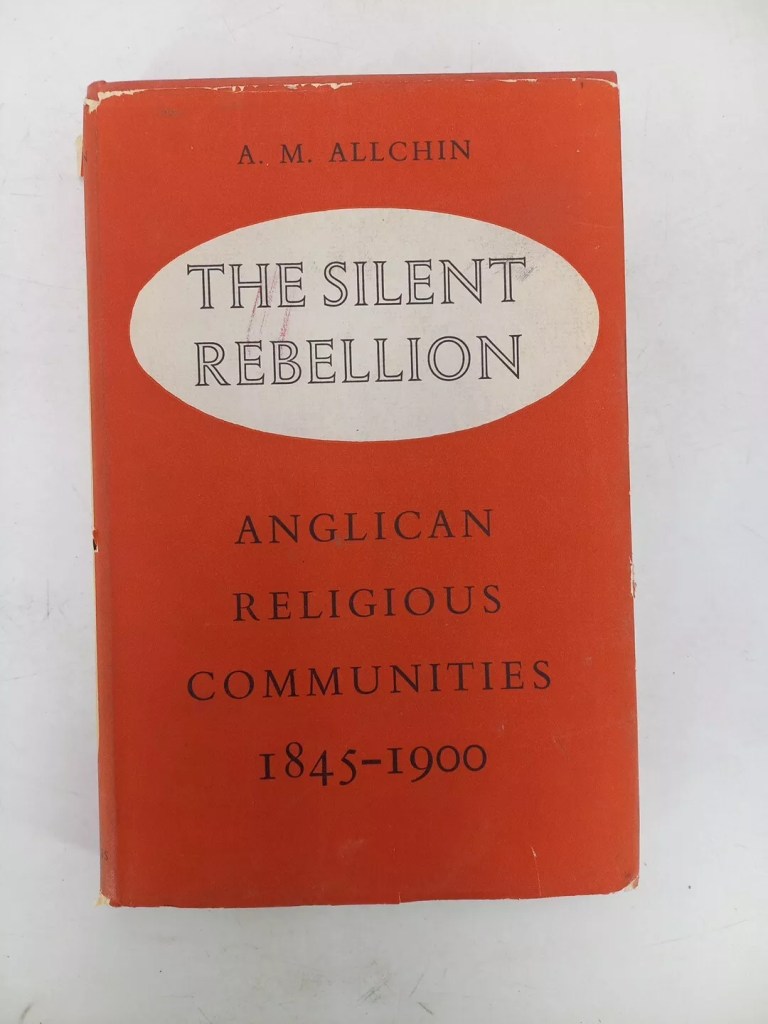
AM Allchin’s The Silent Rebellion is a book on religious life in the Church of England. I do not have a copy but I am looking for one.

It is often pointed out that the title, The Silent Rebellion, highlights the need for solitude for religious life. Yet, why “rebellion”? In what sense is it “a violent uprising“?

While I do not have an answer, this quote may help:

Their name itself, anchorite, means rule-breaker, the one who does not fulfil his public duties.

And maybe this one by Kierkegaard:

…Of this there is no doubt, our age and Protestantism in general may need the monastery again, or wish it were there. The “monastery” is an essential dialectical element in Christianity. We therefore need it out there like a navigation buoy at sea in order to see where we are, even though I myself would not enter it. But if there really is true Christianity in every generation there must also be individuals who have this need…

And from Fear and Trembling:

Faith is exactly this paradox, that the single individual is higher than the universal, but in such a way, mind you, that the movement is repeated, so that after having been in the universal he now as the particular keeps to himself as higher than the universal.

The tragic hero resigns himself in order to express the universal; the knight of faith resigns the universal in order to become the single individual.

The knight of faith, the rebel, stands with Jesus alone even against institutions. There is nothing higher than the individual’s relationship with Jesus – not even religion!

Anyway …

being certain

… skepticism is but the result of our anxious desire to secure certainty by being “at home in the world.”

Harvey, Michael G.. Skepticism, Relativism, and Religious Knowledge

I struggle with what “tomorrow will bring.” I try to control things without much success. So, the above quote hits home (sorry!). Perhaps it is part of the anchorite tradition – the enclosed solitary life – to surrender any hope of certainty? I am thinking especially with other people. Do I have to make myself understood? Or is it that terrible if other people do not “get it”?

I am reading Slavoj Žižek. He is super funny. I think he is the perfect “modern” philosophy! Not for what he says but how he says it. Life is chaotic and unpredictable so why am I trying to be organised and predictable? Life is full of paradoxes and contradictions so maybe just take the leap and live?

All of that is super easy to say but living it is hard. Jesus by your holy wounds, have mercy on me.

Day 0 – questions

With God’s help, I plan to spend January alone. I am praying for a retreat at home.

Sometimes, writing down the question you bring to a retreat is a good idea. So: do I have a vocation to the solitary life? At the moment, I feel like I am using it as an excuse and escape from me. The end of the year was extremely difficult. And I have simply stepped back into old habits and thought patterns. So, to expand the question, do I have a vocation, or am I just running away from me?

I have become more aware of the differences between my view of Christianity and the community/parish. And that has really hurt. I would like to offer the hurt to Jesus as a form of mortification – hand it over to him. But, apart from the spiritual impact, there are impacts on my life-arrangement. In that context, do I have the resolution to start again?

And, to be honest, I feel like it is all me. I am again in a position where I feel I am the problem. In the end, there is no escaping me. Am I, as a person, suited to this life?

So, 31 days of January to work it all out!

Colossians 3

This is the reading for Evensong today (30 December) in the 1922 Lectionary. Prayer, mortification, and seelsorge.

If ye then be risen with Christ, seek those things which are above, where Christ sitteth on the right hand of God. Set your affection on things above, not on things on the earth. For ye are dead, and your life is hid with Christ in God. When Christ, who is our life, shall appear, then shall ye also appear with him in glory. Mortify therefore your members which are upon the earth; fornication, uncleanness, inordinate affection, evil concupiscence, and covetousness, which is idolatry: For which things’ sake the wrath of God cometh on the children of disobedience: In the which ye also walked some time, when ye lived in them. But now ye also put off all these; anger, wrath, malice, blasphemy, filthy communication out of your mouth. Lie not one to another, seeing that ye have put off the old man with his deeds; And have put on the new man, which is renewed in knowledge after the image of him that created him: Where there is neither Greek nor Jew, circumcision nor uncircumcision, Barbarian, Scythian, bond nor free: but Christ is all, and in all. Put on therefore, as the elect of God, holy and beloved, bowels of mercies, kindness, humbleness of mind, meekness, longsuffering; Forbearing one another, and forgiving one another, if any man have a quarrel against any: even as Christ forgave you, so also do ye. And above all these things put on charity, which is the bond of perfectness. And let the peace of God rule in your hearts, to the which also ye are called in one body; and be ye thankful. Let the word of Christ dwell in you richly in all wisdom; teaching and admonishing one another in psalms and hymns and spiritual songs, singing with grace in your hearts to the Lord. And whatsoever ye do in word or deed, do all in the name of the Lord Jesus, giving thanks to God and the Father by him.

Colossians 3:1-17

carthusian seelsorge

To the poor of the world we give bread or whatever else our resources afford or goodwill suggests: we rarely receive them under our roof but instead send them to find lodgings in the village. For it is not for the temporal care of the bodies of our neighbours that we have fled to this desert, but for the eternal salvation of our souls. Therefore it is not surprising if we give more friendship and assistance to those who come here for the sake of their souls than to those who come for the sake of their bodies.

eucharist?

They used to say of Mark the Egyptian that he remained for thirty years never coming out of his cell. The priest was in the habit of coming and celebrating the holy Eucharist for him.

Abba Macarius the Egyptian once came from Scete to the Mount of Nitria for the Eucharist of Abba Pambo.

The elder [Matoes] used to say: “I have faith in God that I do not have much to answer for on account of the ordination, since I do not offer the Eucharist.

Abba Macarius once visited Abba Antony then came back to Scete when he had spoken with him. The fathers came to meet him and, as they were speaking, the elder said to them: “I told Abba Antony that we do not have the Eucharist in our place.”

seelsorge

As we look back on the ordinary, not outstanding, anchoress, we visualize a single lady of some spiritual acumen, living a life of prayer, study, work, and spiritual guidance, in a cottage by the church, while she herself submits to the guidance of the parish priest. There are no “vows”, no exaggerated austerity or poverty, no special habit. Age for age, is it over-straining the facts to see a hint at the much-needed vocation for the many devout Anglican ladies whose spiritual gifts are now so shamefully wasted? It is very wrong for these ladies to force themselves to aspire to a monastic vocation which they know they do not really have. It is worse still when their gifts are squandered on “parish work” of very doubtful value. Is the possibility of some modern adaptation of the anchoress, primarily the spiritual guide of others, so very remote? It is, after all, a typical English compromise to which not a few loyal laywomen are already leaning. But, without pride of position, they need authority and recognition.

Martin Thornton, English Spirituality, 170

Sidestep the rather outdated language: the enclosed solitary as a person engaged in seelsorge. An outsider who can engage people on their pilgrimage with Jesus. And a person who can return to their chapel and bring these people before Jesus in prayer. When we move that reality to the modern age, is the internment.a place for seelsorge? (Personally, I would like to return to handwritten letters, but that is not the case for everyone.)

So, the mission statement of the anchorite is: prayer, mortification, and seelsorge.

… to be a contemplative

To be a contemplative Church means:

  • To be deeply rooted in Christ as a branch in the vine, through prayer and worship, word and sacrament;
  • To be sustained in joy and hope in the midst of a suffering world;
  • To seek the continual grace and renewal of the Holy Spirit in our lives;
  • To value deep wisdom and offer meaning;
  • To take our theology seriously as dialogue with God as well as talk about God;
  • To live in healthy rhythms of prayer and rest and work and be fully human;
  • To be good news in an over active and busy world;
  • To offer the gift of silence, still places and moments of encounter with the living God;
  • To listen deeply to ourselves, to the world in which we live and to one another;
  • To discern God’s call to us as individuals and communities;
  • To wrestle with God;
  • To surrender our doing in order to make space for stillness and dwelling, that God might be free to do and act within us.
Diocese of Oxford

fasts and abstinence

I was thinking about the table of fasts and abstinence in the 1662 Prayer Book. Since nothing like it exists in modern Prayer Books, I assume that it still stands. So, I was wondering what the Prayer Book required of me. I found these PRECEPTS OF THE CHURCH by Bishop John Cosin:

  1. To observe the Festivals and Holy Days appointed.
  2. To keep the Fasting Days with devotion and abstinence.
  3. To observe the ecclesiastical customs and ceremonies established, and that without frowardness or contradiction.
  4. To repair unto the public service of the Church for Matins and Evensong, with other holy offices at times appointed, unless there be a just and unfeigned cause to the contrary.
  5. To receive the Blessed Sacrament of the Body and Blood of Christ with frequent devotion, and three times a year at least, of which Easter to be always one. And for better preparation thereunto, as occasion is, to disburthan and quit your consciences of those sins that may grieve us, or scruples that may trouble us, to a learned and discreet priest, and from him to receive advice, and the benefit of Absolution.

It needs a little re-jigging but I think it is a workable Rule of Life. What thinkest thou?