In those days came John the Baptist, preaching in the wilderness of Judaea, and saying, Repent ye: for the kingdom of heaven is at hand.
Matthew 3:1-2
By what authority does John the Baptist preach?
In those days came John the Baptist, preaching in the wilderness of Judaea, and saying, Repent ye: for the kingdom of heaven is at hand.
Matthew 3:1-2
By what authority does John the Baptist preach?

I do not need the money – I do it for free. Can I bring my books? BCP!
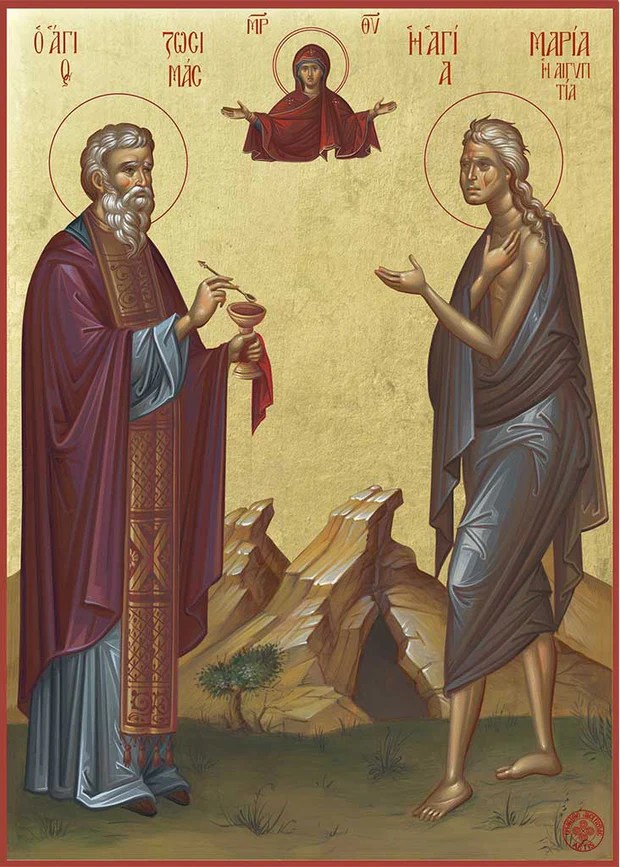
These are the reading for Mattins (alternative First Lesson), the Gospel for Mass from the Book of Common Prayer, and the Collect for the First Sunday in Lent.
My son, if thou come to serve the Lord, prepare thy soul for temptation. Set thy heart aright, and constantly endure, and make not haste in time of trouble. Cleave unto him, and depart not away, that thou mayest be increased at thy last end. Whatsoever is brought upon thee take cheerfully, and be patient when thou art changed to a low estate. For gold is tried in the fire, and acceptable men in the furnace of adversity. Believe in him, and he will help thee; order thy way aright, and trust in him. Ye that fear the Lord, wait for his mercy; and go not aside, lest ye fall. Ye that fear the Lord, believe him; and your reward shall not fail. Ye that fear the Lord, hope for good, and for everlasting joy and mercy. Look at the generations of old, and see; did ever any trust in the Lord, and was confounded? or did any abide in his fear, and was forsaken? or whom did he ever despise, that called upon him? For the Lord is full of compassion and mercy, longsuffering, and very pitiful, and forgiveth sins, and saveth in time of affliction. Woe be to fearful hearts, and faint hands, and the sinner that goeth two ways! Woe unto him that is fainthearted! for he believeth not; therefore shall he not be defended. Woe unto you that have lost patience! and what will ye do when the Lord shall visit you? They that fear the Lord will not disobey his Word; and they that love him will keep his ways. They that fear the Lord will seek that which is well, pleasing unto him; and they that love him shall be filled with the law. They that fear the Lord will prepare their hearts, and humble their souls in his sight, Saying, We will fall into the hands of the Lord, and not into the hands of men: for as his majesty is, so is his mercy.
Ecclesiasticus 2
Then was Jesus led up of the Spirit into the wilderness, to be tempted of the devil. And when he had fasted forty days and forty nights, he was afterward an-hungred. And when the tempter came to him, he said, If thou be the Son of God, command that these stones be made bread. But he answered and said, It is written, Man shall not live by bread alone, but by every word that proceedeth out of the mouth of God. Then the devil taketh him up into the holy city, and setteth him on a pinnacle of the temple, and saith unto him, If thou be the Son of God, cast thyself down; for it is written, He shall give his angels charge concerning thee, and in their hands they shall bear thee up, lest at any time thou dash thy foot against a stone. Jesus said unto him, It is written again, Thou shalt not tempt the Lord thy God. Again, the devil taketh him up into an exceeding high mountain, and sheweth him all the kingdoms of the world, and the glory of them; and saith unto him, All these things will I give thee, if thou wilt fall down and worship me. Then saith Jesus unto him, Get thee hence, Satan; for it is written, Thou shalt worship the Lord thy God, and him only shalt thou serve. Then the devil leaveth him, and behold, angels came and ministered unto him
The Gospel St. Matthew 4.1-11
O Lord, who for our sake didst fast forty days and forty nights: Give us grace to use such abstinence, that, our flesh being subdued to the Spirit, we may ever obey thy godly motions in righteousness and true holiness, to thy honour and glory, who livest and reignest with the Father and the Holy Ghost, one God, world without end. Amen.
The Collect
… commentators distinguish between people who are un-churched (as in never had any significant contact with a church) and those who are de-churched (as in once were involved, but no more thank you very much).
Churched, Un-churched or De-churched
I used the term for the first time yesterday. It was a little of a shock to me. “Yes, I am de-churched but still in love with Jesus”.
It is a gigantic leap to say that the earthly institution we call “church” is the same as the Body of Christ. Even more that a system of thought or decisions of a particular organisation is more important than an individual person. How can any system that is above the individual be acceptable? Obedience is not simply conformity (to an external) but accountability (for my actions). My experience is valid and meaningful to me. The individual’s confession – my confession – is “Jesus is Lord”, not “Jesus and various other things are Lord”. No Jesus+ or faith+. No institution above intimacy.
Sorry, that is a brain dump that was floating in my head for some time. I am not looking for someone to agree with me (or disagree with me). This is simply where Jesus has led me. Anyway …
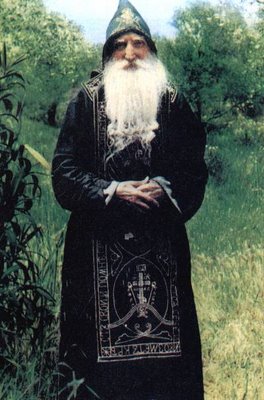
A starets … is an elder of an Eastern Orthodox or Eastern Catholic monastery or convent who functions as venerated adviser and teacher. Elders or spiritual fathers are charismatic spiritual leaders whose wisdom stems from God as obtained from ascetic experience. … Elders are not appointed by any authority; they are simply recognized by the faithful as being people “of the Spirit”. An elder, when not in prayer or in voluntary seclusion, receives visitors (some who travel very far) and spends time conversing with them, offering a blessing (if the elder is an ordained cleric) and confession, and praying. People often petition the elder for intercessionary prayers, believing that the prayer of an elder is particularly effective.
Starets
To this there is a simple answer. The spiritual father or starets is essentially a ‘charismatic’ and prophetic figure, accredited for his task by the direct action of the Holy Spirit. He is ordained, not by the hand of man, but by the hand of God. He is an expression of the Church as “event” or “happening”, rather than of the Church as institution.
The Spiritual Father in Orthodox Christianity
In a world of action, what does the call of Jesus to “follow me” mean? In the world of instant, what does it mean that everything belongs to God?
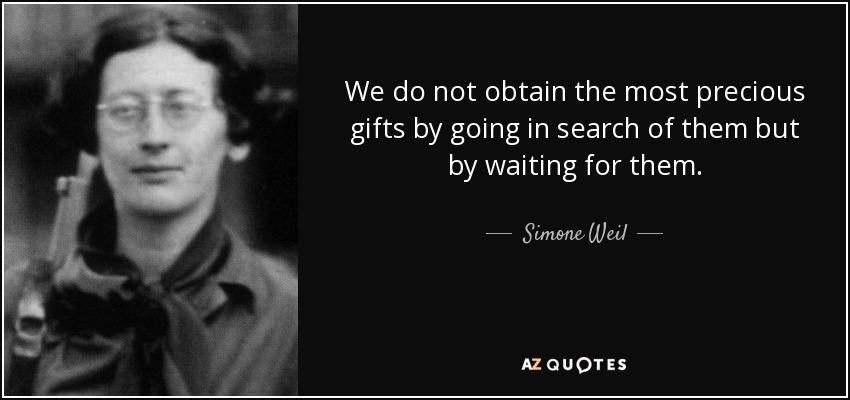
I like Weil – a rebel. She did not join the Church but confessed Jesus as Lord. Do moderns need to learn, from her, that waiting in hope is something to be desired?
But Christendom has abolished Christ; yet, on the other hand, it wants—to inherit him, his great name, to make use of the enormous consequences of his life. Indeed, Christendom is not far from wanting to appropriate them as its own merits and to delude us into thinking that Christendom is Christ.
Soren Kierkegaard
No institution can substitute for a living relationship with Jesus – as much as they may try, Sometimes you just have to stand alone before God!!!
Even so, come Lord Jesus.
I beseech you therefore, brethren, by the mercies of God, that ye present your bodies a living sacrifice, holy, acceptable unto God, which is your reasonable service. And be not conformed to this world: but be ye transformed by the renewing of your mind, that ye may prove what is that good, and acceptable, and perfect, will of God.
Romans 12:1-2 (KJV)
The above is from Second Evensong for Candlemas. It reminded me of one of the post-communion prayers In the Second Order in APBA:
Father,
we offer ourselves to you
as a living sacrifice
through Jesus Christ our Lord.
Send us out in the power of your Spirit
to live and work to your praise and glory.
What does “sacrifice” mean in these two texts? Not death. Perhaps we could define it as the surrender of a good (body in Romans) for a greater good (life in Jesus).
BTW: Augustine makes the opposite his definition of sin:
On account of all these, and such as these, is sin committed; while through an inordinate preference for these goods of a lower kind, the better and higher are neglected — even You, our Lord God, Your truth, and Your law.
Confessions 2:5:10
So, the choice between higher and lower goods is the root of sin and sacrifice.
Anyway …
What is the rebellion of the religious life? Perhaps this quote from Camus:
The only way to deal with an unfree world is to become so absolutely free that your very existence is an act of rebellion.
I have been sick – not much sleep for the last two days. I am not sure how well my medication is working – I guess I will know when I get withdrawals. Anyway, I dreamt last night that I was walking into a church – a nondescript building which I somehow knew was a church. King of strange as I have not been to church for six weeks. There was no person in the church but a hymn was playing:
All to Jesus I surrender,
All to him I freely give;
I will ever love and trust him,
In his presence daily live.Chorus:
I surrender all,I surrender all,
All to thee, my blessed Savior,
I surrender all.All to Jesus I surrender;
Make me, Savior, wholly thine;
Let me feel the Holy Spirit,
Truly know that thou art mine.All to Jesus I surrender,
Lord, I give myself to thee,
Fill me with thy love and power,
Let thy blessing fall on me.
Sometimes I remember my dreams. (I cannot know if I ever forget a dream!) The first thing that came to mind this morning was: What does “all” mean in this hymn? “All to Jesus I surrender – Lord, I give myself to thee”.
Maybe let me put it another way!? Does “all” include:
Anyway …

