The whole monastic state consists of three specific kinds of establishment: either the retirement and solitude of a spiritual athlete, or living in silence with one or two others, or settling patiently in a community. Turn not to the right hand nor to the left, but follow the King’s highway. Of the three ways of life stated above, the second is suitable for many people, for it is said: ‘Woe unto him who is
alone when he falleth’ into despondency or lethargy or laziness or despair, ‘and hath not another among men to lift him up’. ‘For where two or three are gathered in My name, there am I in the midst of them,’ said the Lord.Ladder of Divine Ascent, 1:26
Category: MonasticLife
not in essence but in intensity
Monasticism is the most authentic form of Christian discipleship. As Basil sees it, if we would let the Lord’s grace have its way with us, if we would follow our baptism to its end and keep all the commandments, we would end up in the monastic life. Indeed, Basil’s word (eisagomenoi) for candidates seeking to enter the monastic community is also the word for catechumens, indicating a “link between the ascetic life and baptism.” Basil’s “monks”—as they would later be called and as we call them—“were simply,” Robert Taft writes, “Christians taking the whole business seriously.” The monastic life, then, differs from the life of ordinary discipleship not in essence but in intensity. But what does this most intense Christian life look like in Basil’s thought and practice?
One of the most fascinating features of the fourth-century church is that we get to observe monasticism in its various stages of development, from devoted and pious family to highly organized monastery, from informal household virginity to ritually consecrated virginity.
Stephen Hildebrand, Basil of Caesarea, 125
additions
A couple additions to the blog:
Precepts, duties of life according to the BCP summarised by Bishop John Cosin.
Life in the Desert, Chapter 6 of the Life of St Mary of Egypt – a snapshot of early monasticism.
Clear Creek
the desert and the west
Holy Hesycgia: The STillness that knows God
… the heritage of the Desert Fathers had never been fully assimilated by the Western church,
monasticism?
Monasticism, that is individuals devoting themselves to an ascetic life in a monastery for devotional purposes, was an ever-present feature of the Byzantine empire.
Byzantine Monasticism
The above, I think, is a great working definition. Also, a working definition of “universal call to holiness”.
sacrifice
I beseech you therefore, brethren, by the mercies of God, that ye present your bodies a living sacrifice, holy, acceptable unto God, which is your reasonable service. And be not conformed to this world: but be ye transformed by the renewing of your mind, that ye may prove what is that good, and acceptable, and perfect, will of God.
Romans 12:1-2 (KJV)
The above is from Second Evensong for Candlemas. It reminded me of one of the post-communion prayers In the Second Order in APBA:
Father,
we offer ourselves to you
as a living sacrifice
through Jesus Christ our Lord.
Send us out in the power of your Spirit
to live and work to your praise and glory.
What does “sacrifice” mean in these two texts? Not death. Perhaps we could define it as the surrender of a good (body in Romans) for a greater good (life in Jesus).
BTW: Augustine makes the opposite his definition of sin:
On account of all these, and such as these, is sin committed; while through an inordinate preference for these goods of a lower kind, the better and higher are neglected — even You, our Lord God, Your truth, and Your law.
Confessions 2:5:10
So, the choice between higher and lower goods is the root of sin and sacrifice.
Anyway …
more rebellion …
What is the rebellion of the religious life? Perhaps this quote from Camus:
The only way to deal with an unfree world is to become so absolutely free that your very existence is an act of rebellion.
silent rebellion
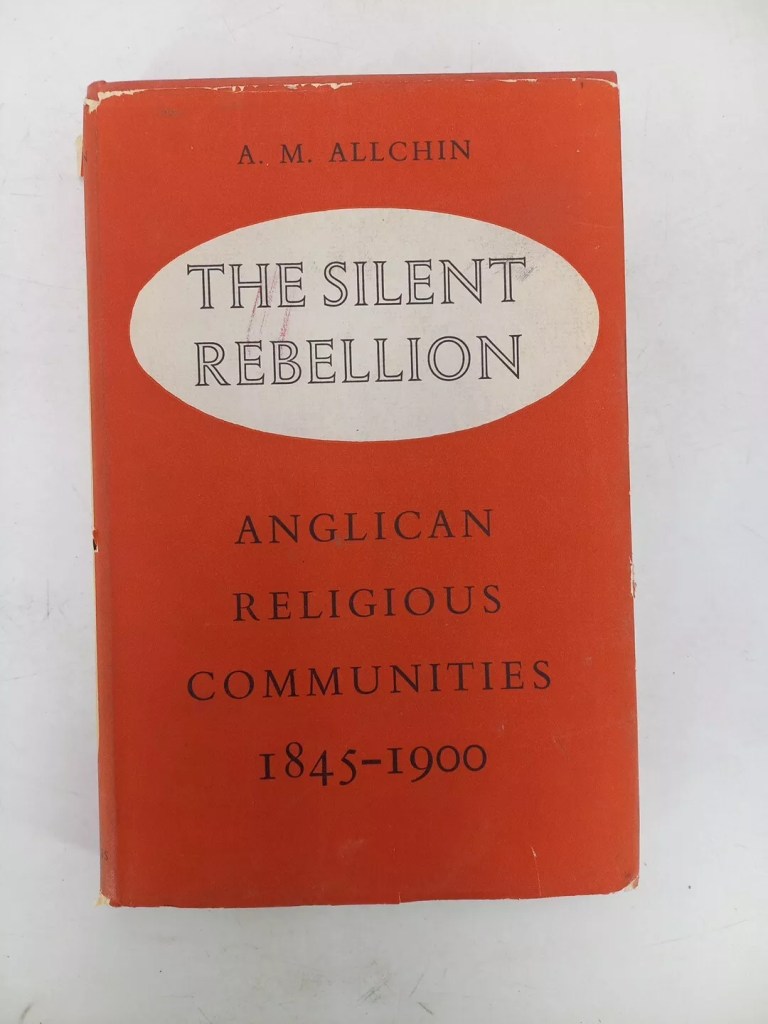
AM Allchin’s The Silent Rebellion is a book on religious life in the Church of England. I do not have a copy but I am looking for one.
It is often pointed out that the title, The Silent Rebellion, highlights the need for solitude for religious life. Yet, why “rebellion”? In what sense is it “a violent uprising“?
While I do not have an answer, this quote may help:
Their name itself, anchorite, means rule-breaker, the one who does not fulfil his public duties.
And maybe this one by Kierkegaard:
…Of this there is no doubt, our age and Protestantism in general may need the monastery again, or wish it were there. The “monastery” is an essential dialectical element in Christianity. We therefore need it out there like a navigation buoy at sea in order to see where we are, even though I myself would not enter it. But if there really is true Christianity in every generation there must also be individuals who have this need…
And from Fear and Trembling:
Faith is exactly this paradox, that the single individual is higher than the universal, but in such a way, mind you, that the movement is repeated, so that after having been in the universal he now as the particular keeps to himself as higher than the universal.
The tragic hero resigns himself in order to express the universal; the knight of faith resigns the universal in order to become the single individual.
The knight of faith, the rebel, stands with Jesus alone even against institutions. There is nothing higher than the individual’s relationship with Jesus – not even religion!
Anyway …

