It seems that by the end of the twelfth century the hermit was beginning to be defined as ‘ascetic’ rather than as one who lives alone.
Ward SLG, Sr Benedicta in Solitude and Communion: Papers on the Hermit Life, 90.
Category: MonasticLife
1 estate in 3 forms
So hear me out: what if the dissolution of the monasteries (under Henry VIII) was not so bad after all? But the real tragedy was the jumping into the same model with rules and canons at the restoration of religious life? What if rather than useful sisterhoods (which only happened because priests needed help) an eastern model was used?
All monks and nuns share the same ascetic call and belong to a single, all-embracing ‘order’ or ‘estate’; yet within that one ‘estate’ there is a wide variety of patterns and a constant flexibility.
So there is one estate – the monastic – which the individual, male or female, enters through tonsure. More freedom! And then the individual has a choice:
The wide variety of patterns is reduced by St John Climacus (d. circa 649) to three main types: “The monastic way of life takes three general forms: to live in ascetic withdrawal and solitude; to be a hesychast with one or two companions; to dwell with patient endurance in a coenobium.” These three forms—the coenobitic, the eremitic, and the middle or semi-eremitic way of the hesychast who dwells with one or two others—are found at the very outset of Christian monasticism in fourth-century Egypt.
Ware, Metropolitan Kallistos; Walls in Solitude and Communion: Papers on the Hermit Life (Fairacres Publications), 48.
So one estate in three forms. With movement between the forms. Some years active, some years solitary, and some years in the middle. Yet there is one more point that is vital and has been complete (methinks) missed in Anglican “religious life”:
… from the start primary importance was attached to the need for personal spiritual direction under an ‘abba’ or ‘elder’—what the Greek sources call a gerôn and what the Russians were later to term a starets. The variety and flexibility of Eastern monasticism must inevitably seem ill-disciplined and untidy to the Western mind, unless it is remembered that underlying this variety there is the direct personal relationship between the spiritual father or mother and his or her child. This relationship, while it ensures inner order within seeming confusion, is not something that can be contained within institutional forms or controlled by rules.
ibid, 51
So one estate in three forms under the guidance of an “elder”. No need to institutionalise. No need for bishops to be involved and worry about vows. The model, methinks, is that of living one’s baptismal life rather than celibate marriage (to Jesus or the Church).
I suspect this was present in the life of anchorites in England before the Reformation:
The ambivalence in this relationship [between monastic rules and ‘rules’ for solitaries] reflects an underlying tension between monastic and anchoritic ideals. The monastic life is based on obedience, the anchoritic life on independence; one requires the renunciation of the will, the other the exercise of free choice.
Innes-Parker, Catherine; Yoshikawa, Naoë Kukita. Anchoritism in the Middle Ages: Texts and Traditions (Religion and Culture in the Middle Ages), 34.
So missed opportunity?
wager!
Life in Religion is the ultimate wager on the existence of God. The Church should always be engaged in doing things that make no sense if God does not exist. This is the reason why I hold the Religious life in the highest esteem. Through the commonality of goods, the life of obedience and above all the commitment to shape life around the Opus Dei (that is, prayer), the monastic life models for all Christians what it means to live fully and abundantly, with and for Christ.
The Most Rev’d Justin Welby, Archbishop of Canterbury (2013 – 2025), Foreword to: Anglican Religious Life 2016-17
St Elisabeth the New Martyr
Not very Orthodox, a lot more western, but most interesting.
aliens!?
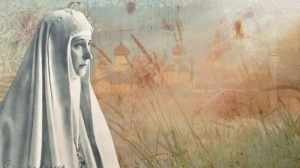
I have started a hall of heroes – a collection of individuals whose faith and life I admire. One of those is St Elisabeth – Princess Elisabeth of Hesse and by Rhine and Grand Duchess Elizabeth Feodorovna of Russia,
So here is an interesting article: A Horizon Beyond the Storm – St Elisabeth’s Gift to Us. (Filled, I must say, with very nice pictures. And, as an aside, St Elisabeth went to the visit Anglican “religious houses” before establishing her own. Now there is a book waiting to be written.)
Just one quote, from St Elisabeth:
We are strangers and pilgrims on the earth. This visible world is but the place of our sorrowful exile. Earthly days are full of deceit. For each one there comes the hour when he must go home, to the Heavenly Fatherland. God’s holy ones await death as the greatest joy. For them, the end of earthly life is the meeting with the Creator, to Whom the soul had ceaselessly reached out. A person who has given himself to God believes that the Lord watches over him in all things. Trusting in God’s saving Providence, he bears every pain and sorrow.
There is much to be said about the Romanvos. And a lot more about audocrarcy. As with all martyrs and passion-bearers, a reminder that this world is not my home. I am an alien!!!!
work it out in humility
If there be therefore any consolation in Christ, if any comfort of love, if any fellowship of the Spirit, if any bowels and mercies, fulfil ye my joy, that ye be likeminded, having the same love, being of one accord, of one mind. Let nothing be done through strife or vainglory; but in lowliness of mind let each esteem other better than themselves. Look not every man on his own things, but every man also on the things of others. Let this mind be in you, which was also in Christ Jesus:
Who, being in the form of God, thought it not robbery to be equal with God: but made himself of no reputation, and took upon him the form of a servant, and was made in the likeness of men: and being found in fashion as a man, he humbled himself, and became obedient unto death, even the death of the cross.
Wherefore God also hath highly exalted him, and given him a name which is above every name: that at the name of Jesus every knee should bow, of things in heaven, and things in earth, and things under the earth; and that every tongue should confess that Jesus Christ is Lord, to the glory of God the Father.
Wherefore, my beloved, as ye have always obeyed, not as in my presence only, but now much more in my absence, work out your own salvation with fear and trembling.
Philippians 2:1-12
… be humble?
To be humble means to consider ourselves deserving, for our sins, of every humiliation, injury, persecution, and even blows; and to be meek means patiently to endure injustice, abuse, et cetera, and to pray for our enemies.
If you wish to be truly humble, then consider yourself lower than all, worthy of being trampled on by all; for you yourself daily, hourly trample upon the law of the Lord, and therefore upon the Lord Himself.
When any one, out of kindness, praises you to others, and they transmit these praises to you, do not consider them as a just tribute of esteem really due to you, but ascribe them solely to the kindness of heart of the person who thus spoke of you, and pray to God for him, that God may strengthen him in his kindness of heart and in every virtue; but acknowledge yourself to be the greatest of sinners, not out of humility, but truthfully, actually, knowing as you do your evil deeds.
A deep feeling of spiritual poverty, a lamentation at the existence of evil, a thirst after salvation, are to be found in every straightforward and humble soul.
Receive every one who comes to you, especially with a spiritual purpose, with a kind and cheerful aspect, although he or she may be a beggar, and humble yourself inwardly before everybody, counting yourself lower than he or she, for you are placed by Christ Himself to be the servant of all, and all are His members, although like you they bear the wounds of sin.
There is absolutely nothing for a Christian to be proud of in accomplishing works of righteousness, for he is saved, and is being constantly saved, from every evil through faith alone, in the same manner as he accomplishes works of righteousness also by the same faith. “For by grace you are saved through faith, and that (faith itself) not of yourselves, for it is the gift of God; not of works, that no man may glory.” So that no one can be proud of anything.
Spiritual poverty consists in esteeming oneself as though not existing, and God alone as existing; in honouring His words above everything in the world, and in not sparing anything to fulfil them, even one’s own life; in considering God’s Will in everything, both for ourselves and others, entirely renouncing our own will. The man who is poor in spirit desires and says with his whole heart: “Hallowed be Thy name, Thy kingdom come, Thy will be done in earth as it is in heaven.” It is as though he himself disappears; everywhere and in everything he wishes to see God – in himself and in others. “Let every thing be Thine, not mine.” He wishes to contemplate God’s holiness in himself and in all His kingdom, also His will; also to see Him alone entirely filling the human heart, as it should be, because He alone is all-merciful and all-perfect, all-creating; whilst the enemy -the Devil and his instruments, and those who oppose God – are thieves in the kingdom of God, and adversaries of God. To him who is poor in spirit the whole world is as nothing. Everywhere he sees God alone giving life to everything, and ruling everything; for him there is no place without God, no moment without God; everywhere and at every minute he is with God, and as though with Him alone. He who is poor in spirit does not dare and does not think of trying to comprehend the incomprehensible, to discover God’s mysteries, to philosophise on the highest; he believes in the single word of the Lord, the Life-giver, knowing that every word of His is truth, spirit, and eternal life; and in the words of His Church, ever instructed in all truth by the Holy Ghost, he believes as a child believes his father or mother, not requiring proofs, but perfectly relying upon them. He who is poor in spirit considers himself the very last and the most sinful of all, reckons himself worthy of being trampled under foot by every one.
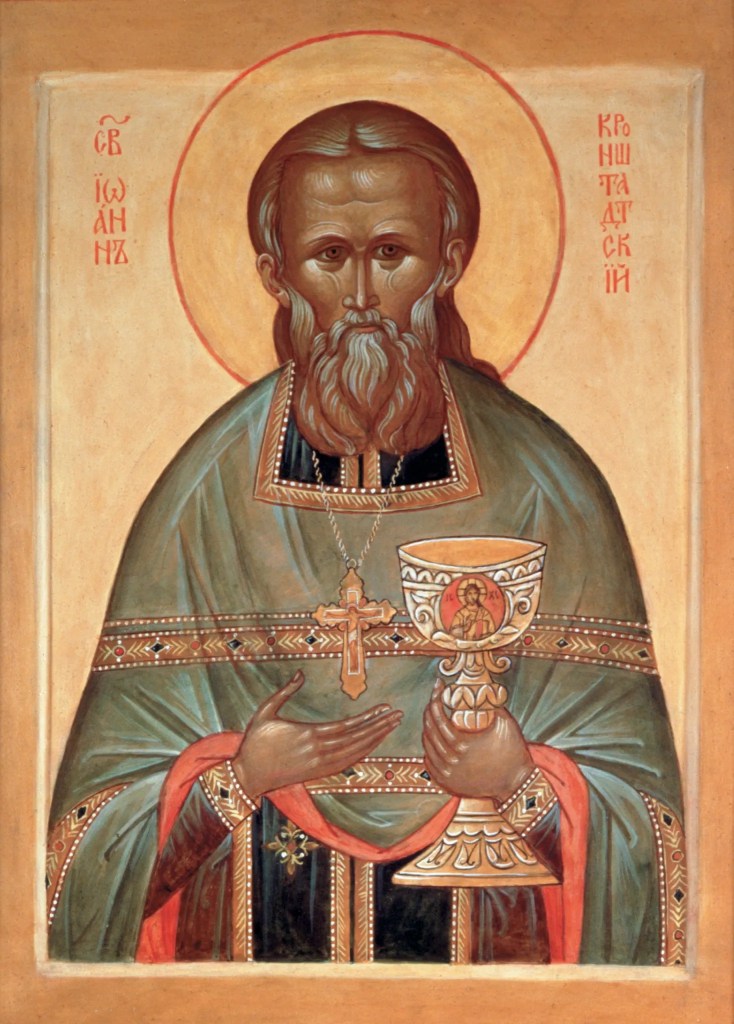
St John of Kronstadt
warning?
But above all, grace is attributed to you, that you call me by name, whom you have never seen. But since grace is not known by dignity, but is accustomed to be signified by the actions of souls, bless for the sake of God, and grant a prayer of your perfection’s indulgence.
St. Sophronius of Jerusalem. Life of St. Mary of Egypt (p. 15). (Function). Kindle Edition.
A desert encounter! Two people who have never meet. But grace is obvious!
Being “clergy” does not mean grace! Nor insight. Nor faith.
the “battle”
By avoiding being recognised as an institution, monasticism remains hidden from the eyes of this world, and this allows it to keep its perfect and absolute freedom to exist purely on the spiritual plane, governed exclusively by the power of the Holy Spirit. If monasticism were to become an institution, it would cease to be a life ‘outside the camp of this world;’(Heb 13:13) it would lose its charismatic power of humility and its prophetic and paradoxical character, whereby it maintains the knowledge of God on earth.
Zacharou, Archimandrite Zacharias. Monasticism: The All-Embracing Gift of the Holy Spirit (p. 8). (Function). Kindle Edition.
“To be or not to be” is not an institutional question. For me, the “battle” is the urge (the desire) for an “institutional yes”. But outside means outside the institution.
from St Andrew’s Service Book
A Table of Fast and Abstinence
Strict Fast Days
Ash Wednesday Good Friday
Wednesdays and Fridays are days of abstinence throughout the year.
Fast Periods During the Year:
- Advent
- The Forty Days of Lent
- The Ember Days at the four seasons, being the Wednesday, Friday, and Saturday after the First Sunday in Lent, the Feast of Pentecost, September 14, and December 13.
The Wednesdays and Fridays that fall during a fast period are considered days of fast and abstinence.
Note: There is no fast or abstinence of any kind from Christmas Day to the eve of Epiphany, or from Easter to the following Sunday.
Abstinence means to avoid eating certain kinds of food; e.g., flesh meat, dairy products.
Fasting means to reduce the amount of food eaten, generally to one and one-half meals per day.

