relationship and affections

I think this is the principal reason why the invisible God willed to be seen in the flesh and to converse with people as a person. He wanted to recapture the affections of carnal humanity who were unable to love in any other way, by first drawing them to the salutary love of his own humanity, and then gradually to raise them to a spiritual love.

St Bernard of Clairvaux

In Michael Casey’s book on Lectio Divina, Sacred Reading, he makes the point that relationships and bonds between persons are emotional in nature. I have never really thought about that but I suspect it is very true. (Yes, very true!) In a modern context, maybe we are tempted to intellectualize relationships into common aims and common beliefs. But what bonds me to you is my feelings for you.

The above from St Bernard reminds me of Kierkegaard’s story of the king who falls in love with his servant. Love should be freely given and not forced. The Incarnation is an invitation to love on “my level”. Jesus does not force love but offers it.
gift of tears

I have not written for some time. I guess one day in lockdown looks very much like the next. That is not bad – just the reality of life.

So I have been thinking about the gift of tears. Yes, a somewhat weird thought. I have cried more in the last six months than the whole of my life combined. Not always spiritual, but sometimes spiritual related.

Here is a quote by Ignatius of Loyola:

As for the third point, that is, inflicting hurt upon the body for our Lord’s sake, I would completely stop any practices that could draw even a drop of blood. And if his Divine Majesty has bestowed grace upon you for this and the rest that I have mentioned (as I am convinced in his divine goodness that he has), I think that for the future (without giving reasons or arguments for it) it would be much better to give all this up and instead of seeking to draw any blood, to seek the Lord of all in a more immediate way; that is to say, his most holy gifts—for example, an infusion or drops of tears, whether (1) at our own or other people’s sins, (2) at the mysteries of Christ our Lord in this life or the next, or (3) at the consideration and love of the divine Persons. These tears have greater value and worth in proportion as the thoughts and considerations prompting them are higher.

Ignatius on Prayer (1548)

Tears are signs of intense emotions. Often uncontrollable. But every tear speaks! And should we not have “intense emotions” towards Jesus? I cry during silly movies, why not during the gospel reading on Sunday? (Ok, I have cried a couple of times during sermons but that was out of frustration.)

So, final question: would you pray for the gift of tears?

vocation?

What I really need is to get clear about what I must do, not what I must know, except insofar as knowledge must precede every act. What matters is to find a purpose, to see what it really is that God wills that I shall do; the crucial thing is to find a truth which is truth for me, to find the idea for which I am willing to live and die.

1 August 1835

I have been thinking a lot about vocation. Do I have one? And if so, what is it? Is it from me or from God? What if I tell people and they laugh?

This morning I thought about one of the earliest pieces that people normally read when they start with Kierkegaard – the journal entry for 1 August 1835. And, in particular, it is the end, “and die”. Is the vocation something I am willing to die for? Or, to put it another way, am I willing to live it for the rest of my life? No matter what the cost. If so, whether the church says it is a vocation, or other people, because less relevant. Yes, God speaks through others! But am I dedicated enough to stick it out to the very end even under opposition.

And then I thought about a quote from a book I have been reading (which I think I have shared before):

And it is in this sense that it has been rightly said that monasticism is a kind of substitute for mar­tyrdom.

I am not sure what a “substitute” means in this context. And I know that various forms of monasticism have sometimes been called “white martyrdom”. So putting it all together I am still as clueless as always!!!

So …

I have renewed my blog for another year. In a year, I have no idea where I will be – emotionally, spiritually, or physically – but I am taking a “leap into faith”. I have a very strong sense of what God wants from me but since we are in lockdown I have not had the opportunity to talk to people about it. Life needs to unfold and I simply need to be patient and wait.

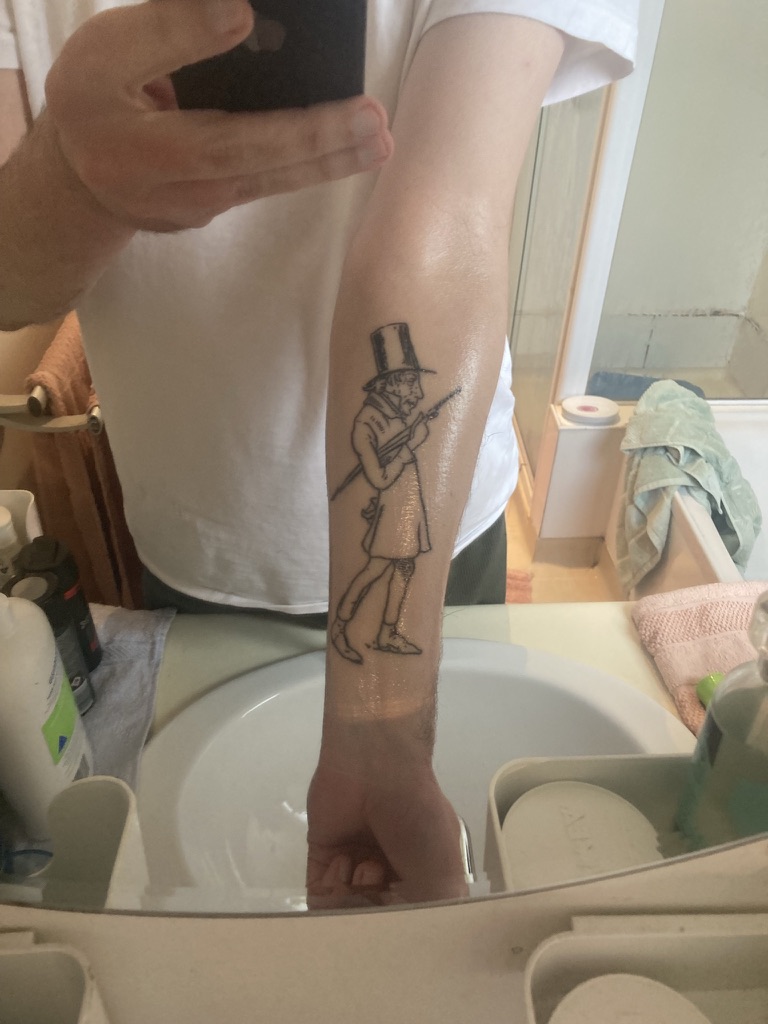
Kierkegaard tattoo

So I wanted to share this picture:

For my birthday I got a tattoo. Something I never thought I would do. But I am so happy with the whole experience that I am thinking about what to get for the other arm. Sorry, a bathroom selfie is not very aesthetic.

Today I am getting my first dose of the Covid vaccine. And, in an ironic twist, I am a little worried that it will hurt. So pray for me!

to be chosen

God is present in the moment of choice, not in order to watch but in order to be chosen. Therefore, each person must choose. Terrible is the battle, in a person’s innermost being, between God and the world. The crowning risk involved lies in the possession of choice.

Søren Kierkegaard

Does anyone have a source for the above quote?

manage people

… because everyone is drawn almost irresistibly back towards this urge to manage.

Rowan Williams. Silence and Honey Cakes, 26.

I have been reading Silence and Honey Cakes – a book by Archbishop of Canterbury Rowan Williams on desert spirituality. It was recommended to me by a lecture in history at a Catholic theological institute.

The above – “this urge to manage” – is a very strong image for me in the first chapter. The withdrawal into the desert is not a withdrawal from a sinful world but an opening of my own sinfulness. And at the core of this is my need to manage people. To set limits on other people’s access to God and to always place myself between God and people. To make myself the spiritual guru, the person with the answers, the person who has it all worked out. To place myself above the other is not an act of love but hubris.

But that is nothing but my sinfulness. And in silence, I hear that most clearly. The desert is not a place but part of my heart that I need to listen to intently. Only when I know what it means to be broken can I really appreciate what it means to be whole – or holy!

John 6:24-35

The lectionary continues the journey through John 6. It skips a couple of verses but the overall flow is still there.

[The next day the crowd that had stayed on the other side of the sea saw that there had been only one boat there. They also saw that Jesus had not got into the boat with his disciples, but that his disciples had gone away alone. Then some boats from Tiberias came near the place where they had eaten the bread after the Lord had given thanks.] So when the crowd saw that neither Jesus nor his disciples were there, they themselves got into the boats and went to Capernaum looking for Jesus.

When they found him on the other side of the sea, they said to him, “Rabbi, when did you come here?” Jesus answered them, “Very truly, I tell you, you are looking for me, not because you saw signs, but because you ate your fill of the loaves. Do not work for the food that perishes, but for the food that endures for eternal life, which the Son of Man will give you. For it is on him that God the Father has set his seal.” Then they said to him, “What must we do to perform the works of God?” Jesus answered them, “This is the work of God, that you believe in him whom he has sent.” So they said to him, “What sign are you going to give us then, so that we may see it and believe you? What work are you performing? Our ancestors ate the manna in the wilderness; as it is written, ‘He gave them bread from heaven to eat.’” Then Jesus said to them, “Very truly, I tell you, it was not Moses who gave you the bread from heaven, but it is my Father who gives you the true bread from heaven. For the bread of God is that which comes down from heaven and gives life to the world.” They said to him, “Sir, give us this bread always.”

Jesus said to them, “I am the bread of life. Whoever comes to me will never be hungry, and whoever believes in me will never be thirsty.

John 6:[22-23]24-35

The introduction – setting the scene – reminds me very much of Fear and Trembling. The double movement of faith – surrender and receive – setting out mind on things above and receive the Bread of Life.