aliens!?

I have started a hall of heroes – a collection of individuals whose faith and life I admire. One of those is St Elisabeth – Princess Elisabeth of Hesse and by Rhine and Grand Duchess Elizabeth Feodorovna of Russia,

So here is an interesting article: A Horizon Beyond the Storm – St Elisabeth’s Gift to Us. (Filled, I must say, with very nice pictures. And, as an aside, St Elisabeth went to the visit Anglican “religious houses” before establishing her own. Now there is a book waiting to be written.)

Just one quote, from St Elisabeth:

We are strangers and pilgrims on the earth. This visible world is but the place of our sorrowful exile. Earthly days are full of deceit. For each one there comes the hour when he must go home, to the Heavenly Fatherland. God’s holy ones await death as the greatest joy. For them, the end of earthly life is the meeting with the Creator, to Whom the soul had ceaselessly reached out. A person who has given himself to God believes that the Lord watches over him in all things. Trusting in God’s saving Providence, he bears every pain and sorrow.

There is much to be said about the Romanvos. And a lot more about audocrarcy. As with all martyrs and passion-bearers, a reminder that this world is not my home. I am an alien!!!!

… be humble?

To be humble means to consider ourselves deserving, for our sins, of every humiliation, injury, persecution, and even blows; and to be meek means patiently to endure injustice, abuse, et cetera, and to pray for our enemies.

If you wish to be truly humble, then consider yourself lower than all, worthy of being trampled on by all; for you yourself daily, hourly trample upon the law of the Lord, and therefore upon the Lord Himself.

When any one, out of kindness, praises you to others, and they transmit these praises to you, do not consider them as a just tribute of esteem really due to you, but ascribe them solely to the kindness of heart of the person who thus spoke of you, and pray to God for him, that God may strengthen him in his kindness of heart and in every virtue; but acknowledge yourself to be the greatest of sinners, not out of humility, but truthfully, actually, knowing as you do your evil deeds.

A deep feeling of spiritual poverty, a lamentation at the existence of evil, a thirst after salvation, are to be found in every straightforward and humble soul.

Receive every one who comes to you, especially with a spiritual purpose, with a kind and cheerful aspect, although he or she may be a beggar, and humble yourself inwardly before everybody, counting yourself lower than he or she, for you are placed by Christ Himself to be the servant of all, and all are His members, although like you they bear the wounds of sin.

There is absolutely nothing for a Christian to be proud of in accomplishing works of righteousness, for he is saved, and is being constantly saved, from every evil through faith alone, in the same manner as he accomplishes works of righteousness also by the same faith. “For by grace you are saved through faith, and that (faith itself) not of yourselves, for it is the gift of God; not of works, that no man may glory.” So that no one can be proud of anything.

Spiritual poverty consists in esteeming oneself as though not existing, and God alone as existing; in honouring His words above everything in the world, and in not sparing anything to fulfil them, even one’s own life; in considering God’s Will in everything, both for ourselves and others, entirely renouncing our own will. The man who is poor in spirit desires and says with his whole heart: “Hallowed be Thy name, Thy kingdom come, Thy will be done in earth as it is in heaven.” It is as though he himself disappears; everywhere and in everything he wishes to see God – in himself and in others. “Let every thing be Thine, not mine.” He wishes to contemplate God’s holiness in himself and in all His kingdom, also His will; also to see Him alone entirely filling the human heart, as it should be, because He alone is all-merciful and all-perfect, all-creating; whilst the enemy -the Devil and his instruments, and those who oppose God – are thieves in the kingdom of God, and adversaries of God. To him who is poor in spirit the whole world is as nothing. Everywhere he sees God alone giving life to everything, and ruling everything; for him there is no place without God, no moment without God; everywhere and at every minute he is with God, and as though with Him alone. He who is poor in spirit does not dare and does not think of trying to comprehend the incomprehensible, to discover God’s mysteries, to philosophise on the highest; he believes in the single word of the Lord, the Life-giver, knowing that every word of His is truth, spirit, and eternal life; and in the words of His Church, ever instructed in all truth by the Holy Ghost, he believes as a child believes his father or mother, not requiring proofs, but perfectly relying upon them. He who is poor in spirit considers himself the very last and the most sinful of all, reckons himself worthy of being trampled under foot by every one.

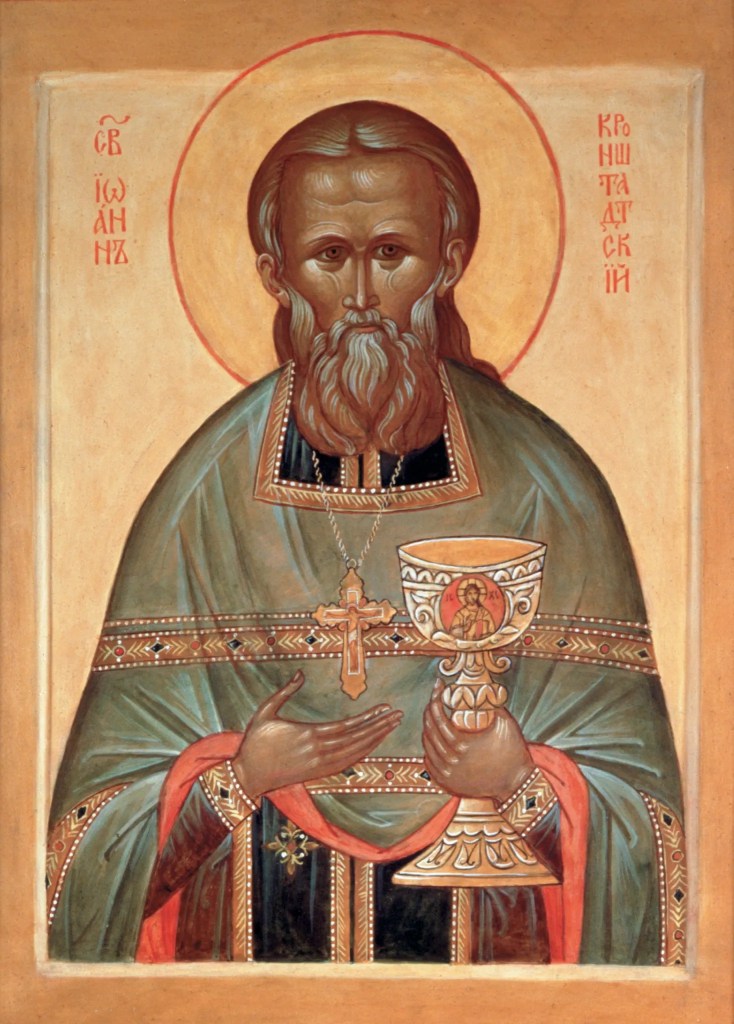
St John of Kronstadt
from St Andrew’s Service Book

A Table of Fast and Abstinence

Strict Fast Days
Ash Wednesday Good Friday

Wednesdays and Fridays are days of abstinence throughout the year.

Fast Periods During the Year:

  • Advent
  • The Forty Days of Lent
  • The Ember Days at the four seasons, being the Wednesday, Friday, and Saturday after the First Sunday in Lent, the Feast of Pentecost, September 14, and December 13.

The Wednesdays and Fridays that fall during a fast period are considered days of fast and abstinence.

Note: There is no fast or abstinence of any kind from Christmas Day to the eve of Epiphany, or from Easter to the following Sunday.

Abstinence means to avoid eating certain kinds of food; e.g., flesh meat, dairy products.

Fasting means to reduce the amount of food eaten, generally to one and one-half meals per day.

battle for blessing

I am reading the Life of St Mary of Egypt. It is so edifying. Zosimus is always adding tears to tears and Mary is an example of true humility. And, the real insight for me, the battle for a blessing at their meeting:

After many hours had passed, the woman said to Zosimus: “Abba Zosimus, it is fitting for you to bless and pray; for you are supported by the honor of the priesthood, and for many years you have assisted at the holy altar, and you explore the secrets of the gifts of Christ’s divinity.”

…

But above all, grace is attributed to you, that you call me by name, whom you have never seen. But since grace is not known by dignity, but is accustomed to be signified by the actions of souls, bless for the sake of God, and grant a prayer of your perfection’s indulgence.”

St. Sophronius of Jerusalem. Life of St. Mary of Egypt, 14.

St Mary blesses Zosimus who then brings her Holy Communion. A truly remarkable account of life in Jesus. Read!!!!!

fasting-days

¶ Then the Curate shall declare unto the people what Holy-days, or Fasting-days, are in the week following to be observed. And then also (if occasion be) shall notice be given of the Communion; and Briefs, Citations, and Excommunications read. And nothing shall be proclaimed or published in the Church during the time of Divine Service, but by the Minister: nor by him any thing but what is prescribed in the Rules of this Book, or enjoined by the King, or by the Ordinary of the place.

Why declare the Fasting-days, if they are not part of the life of the BCP? Or Anglicanism?

long hair

The significance of the Nazarene vow was a sign of God’s power resting on the person who made it. To cut off the hair meant to cut off God’s power as in the example of Samson (see Judges 16:17-19). The strength of these pious observances, transmitted to the New Testament Church, were observed without question till our present times of willfulness and the apostasy resulting from it. Why, one might ask, do those Orthodox clergymen, while rejecting the above pious ordinances about hair, continue to observe the custom of granting various head coverings to clergy, a practice which also has its roots in the ancient ordinances of the Old Testament (cf. Ex. 24:4-6) and the tradition of the early Church (see Fusebius and Epiphanius of Cyprus concerning the miters worn by the Apostles John and James)?

Concerning the Tradition of Long Hair and Beards

the nazirite

The simplest form of the ascetical life: the Nazirite.

All the days of his separation he is holy unto the Lord.

Numbers 6:8

Vow: I will not cut my hair

All the days of the vow of his separation there shall no razor come upon his head: until the days be fulfilled, in the which he separateth himself unto the Lord, he shall be holy, and shall let the locks of the hair of his head grow.

Numbers 6:5

Vow: I will not drink any alcohol

He shall separate himself from wine and strong drink, and shall drink no vinegar of wine, or vinegar of strong drink, neither shall he drink any liquor of grapes, nor eat moist grapes, or dried.

Numbers 6:3

Links:
The Nazir and the Nazirite Vow

1 John 2

Love not the world, neither the things that are in the world. If any man love the world, the love of the Father is not in him. For all that is in the world, the lust of the flesh, and the lust of the eyes, and the pride of life, is not of the Father, but is of the world. And the world passeth away, and the lust thereof: but he that doeth the will of God abideth for ever.

Little children, it is the last time: and as ye have heard that antichrist shall come, even now are there many antichrists; whereby we know that it is the last time. They went out from us, but they were not of us; for if they had been of us, they would no doubt have continued with us: but they went out, that they might be made manifest that they were not all of us. But ye have an unction from the Holy One, and ye know all things.

I have not written unto you because ye know not the truth, but because ye know it, and that no lie is of the truth. Who is a liar but he that denieth that Jesus is the Christ? He is antichrist, that denieth the Father and the Son. Whosoever denieth the Son, the same hath not the Father: he that acknowledgeth the Son hath the Father also.

Let that therefore abide in you, which ye have heard from the beginning. If that which ye have heard from the beginning shall remain in you, ye also shall continue in the Son, and in the Father. And this is the promise that he hath promised us, even eternal life.

These things have I written unto you concerning them that seduce you. But the anointing which ye have received of him abideth in you, and ye need not that any man teach you: but as the same anointing teacheth you of all things, and is truth, and is no lie, and even as it hath taught you, ye shall abide in him.

And now, little children, abide in him; that, when he shall appear, we may have confidence, and not be ashamed before him at his coming. If ye know that he is righteous, ye know that every one that doeth righteousness is born of him.

15-29

only the individual

When Jesus came into the coasts of Caesarea Philippi, he asked his disciples, saying, Whom do men say that I the Son of man am? And they said, Some say that thou art John the Baptist: some, Elias; and others, Jeremias, or one of the prophets. He saith unto them, But whom say ye that I am? And Simon Peter answered and said, Thou art the Christ, the Son of the living God. And Jesus answered and said unto him, Blessed art thou, Simon Barjona: for flesh and blood hath not revealed it unto thee, but my Father which is in heaven.

Matthew 16:13-17

From “whom do [others] say I am” to “whom say ye (pl)” to “Simon Peter answered”.

The interesting thing is that a single individual answers because the question is ultimately only answerable by an individual. Jesus makes this plain by using the singular when He answers Peter.

So my point: only you can answer the question, “Whom say ye that I am?” Not the past, nor the community that surrounds you, but only the single individual standing alone before God. It is the personal encounter with Jesus that asks for a response. And this response changes everything!