It is intrinsic to ascetical theology to adapt itself to the contemporary situation, yet it can only evolve out of a living tradition with roots in the past.
English Spirituality, 13
Category: Asceticism
Theodore the Studite
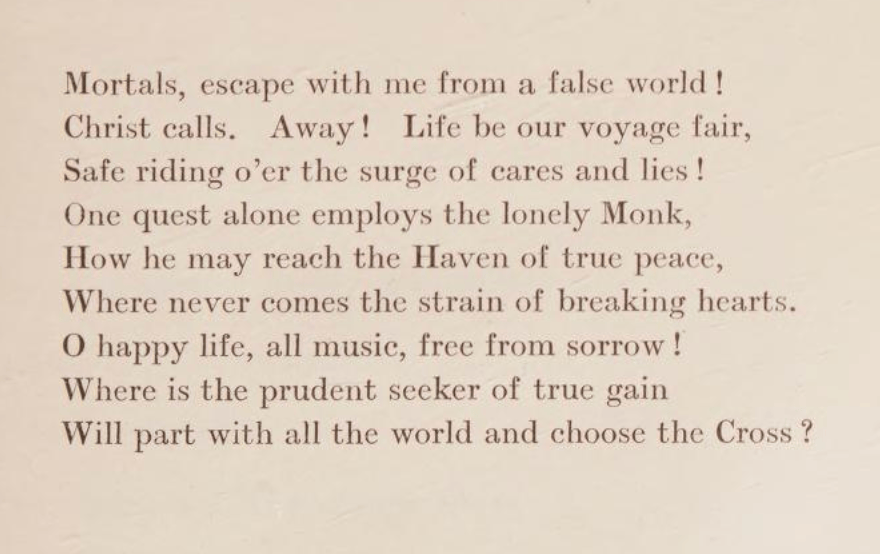
Mortals, escape with me from a false world!
Christ calls. Away! Life be our voyage fair,
Safe riding o’er the surge of cares and lies!
One quest alone employs the lonely Monk,
How he may reach the Haven of true peace,
Where never comes the strain of breaking hearts.
O happy life, all music, free from sorrow!
Where is the prudent seeker of true gain
Will part with all the world and choose the Cross?
old rite!?
move to the forest …
There was a prompt, “What is your biggest dream?” I wrote “to be alone“. But this says it much better than I can!!!!!
spiritual “fathers”
I write not these things to shame you, but as my beloved sons I warn you. For though ye have ten thousand instructers in Christ, yet have ye not many fathers: for in Christ Jesus I have begotten you through the gospel. Wherefore I beseech you, be ye followers of me.
1 Corinthians 4:13-15
second apostolic succession
There are in a sense two forms of apostolic succession within the life of the Church. First there is the visible succession of the hierarchy, the unbroken series of bishops in different cities . . . Alongside this, largely hidden, existing on a “charismatic” rather than an official level, there is secondly the apostolic succession of the spiritual fathers and mothers in each generation of the Church, the succession of the saints. …
Bishop Kallistos Ware of Diokleia in Spiritual Treasure in Filthy Rags: An Introduction to the Paisian Tradition through the Optina Elders, 5.
mattins and evensong
… Wherefore, except Vespers and Nocturns, there are no public services among them in the day except on Saturday and Sunday, when they meet together at the third hour for the purpose of Holy Communion.
Institutes (Book III)
enclosed garden
Similar to contemplative monasteries, the Office is kept in Warfhuizen. In Western Christianity, that is often prayed in accordance with the precepts of Saint Benedict, but in 2009, the hermit switched to the Office of Saint John Cassian from the 5th century. John of Cassian based his schedule on the customs of the hermits in the Egyptian desert, the so-called Desert Fathers, making it very suitable for hermits.
Instead of the eight (usually short) Benedictine offices, Cassian prescribes two (longer) vigils, one at the start and one at the end of the night. In Warfhuizen, these vigils are sung softly in Latin. The other hours do not have an office with Psalms, but are prayed in silence using the Jesus Prayer.
As such, the Office currently used in Warfhuizen clearly deviates from that of the ancient Dutch hermits, who usually used an abbreviated Liturgy of the Hours of Benedict. The influence of the Limburgian tradition on the atmosphere in the hermitage remains clearly noticeable through the various additions from popular devotions, such as praying the Rosary and various litanies, which are sung out loud at various moments during the day. The chapel’s decorations are also a continuation of 17th century examples, through Baroque elements. The devotion to Saint Gerlach of Houthem, of whom there is a reliquary in the retable of the right side altar, has a special place in the hermitage. Saint Anthony Abbot is also especially honoured, with a relic of his kept in the Holy Cross altar.
In addition to the old southern tradition, there are also other influences on the liturgy. The fact that some volunteers are Russian Orthodox has led to the Jesus Prayer being sung in Greek after Compline. The Carthusian tradition is also noticeable in the manner of Gregorian chant.
Our Lady of the Enclosed Garden
Russian spirituality has had an enormous influence on my spiritual life for years, if only because of the Startsi. The Startsi – singular starets – are monks who act as the spiritual father of an entire region, including the monastery where they live. They represent, as it were, the father of the prodigal son,* the spiritual home where you are always welcome and where warmth, safety, and good advice are in abundance.
The sleeping fathers of Kiev (Google translate)
spirituality not religion?
Eremitical life is an expression of spirituality, not religion. When a culture is in a period of profound flux, we spontaneously reach for whatever provides us with a sense of stability. If the religious practices to which we have been accustomed fail to meet our needs, we begin to dig more deeply, bypassing inadequate expressions, usually incarnated in communal formulations, to find our individual roots in the Spirit. Since the end of World War II, there has been a gradual revival of hermit life in Western Christianity. This surprising development is too young yet to be thoroughly analyzed or its fruits fully appraised. At this point, all we have is anecdotal information; experiences related by those who are living this lifestyle in a culture that does not understand it.
Consider the Ravens: On Contemporary Hermit Life
bcp ascetics?
So, here is my reworking of John Cosins’ Precepts:
- To use a liturgical calender
- To fast
- To use an approved BCP (ie: no extras!)
- To say Morning and Evening Prayer
- To receive Holy Communion (at least once a year)
- To seek the advice (counsel) of a spiritual elder
Or: Renunication, Prayer, and Accountability

