philosopher

What’s a book you never finished but still think about?

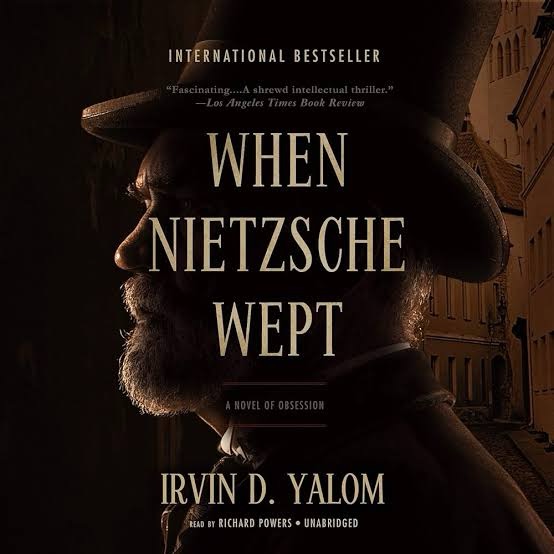
I could mention a number of books but here is one: When Nietzsche Wept.

TBH: I found it a little pompous and the plot with very slow. I like the subject – Nietzsche’s relationship with Lou Salomé – and the general premise is very promising but somehow does not deliver for me.

It is one of those books where I get to a certain point, wonder what is happening next, and then cannot go on. But always wonder how it ends. Maybe I should skip to the end and find out!?

prayer and fasting

Council of Chalcedon
Canon IV.

Let those who truly and sincerely lead the monastic life be counted worthy of becoming honour; but, forasmuch as certain persons using the pretext of monasticism bring confusion both upon the churches and into political affairs by going about promiscuously in the cities, and at the same time seeking to establish Monasteries for themselves; it is decreed that no one anywhere build or found a monastery or oratory contrary to the will of the bishop of the city; and that the monks in every city and district shall be subject to the bishop, and embrace a quiet course of life, and give themselves only to fasting and prayer, remaining permanently in the places in which they were set apart; and they shall meddle neither in ecclesiastical nor in secular affairs, nor leave their own monasteries to take part in such; unless, indeed, they should at any time through urgent necessity be appointed thereto by the bishop of the city. And no slave shall be received into any monastery to become a monk against the will of his master. And if any one shall transgress this our judgment, we have decreed that he shall be excommunicated, that the name of God be not blasphemed. But the bishop of the city must make the needful provision for the monasteries.

Henry R. Percival. The Seven Ecumenical Councils of the Undivided Church: their Canons and Dogmatic Decrees

BCP and fasting?

I asked this on FB so …

For those in the know (you know who you are): with the revision of the Prayer Book, what is the canonical standing of the “Tables and Rules for the Feasts and Fasts through the whole Year”?

Is an Anglican to keep these fasts?

There is an ascetic system enshrined in BCP (1662) – a discipleship way. But I have never heard anyone speak of it?

The Religious Societies of the seventeenth century offer most practical and important witness. Associated with Anthony Horneck’s ministry at the Savoy Chapel, London, and later with William Beveridge and Robert Nelson, these societies arose as an attempt – and a successful one – to practise the full teaching of the Church as enshrined in the Book of Common Prayer. The initial influence of these societies, these “Faithful Remnants”, was enormous, and history supports their sanity and zeal. The recitation of the daily Office was central to their activity, a priest-director was an essential part of the system, while works of charity towards the poor were a natural outcome. It is significant that their demise came when extraneous interests in politics and sociology overbalance the original Godward intention. For most of our modern parochial organizations, the writing on the wall could hardly be plainer.

English Spirituality

what has happened …

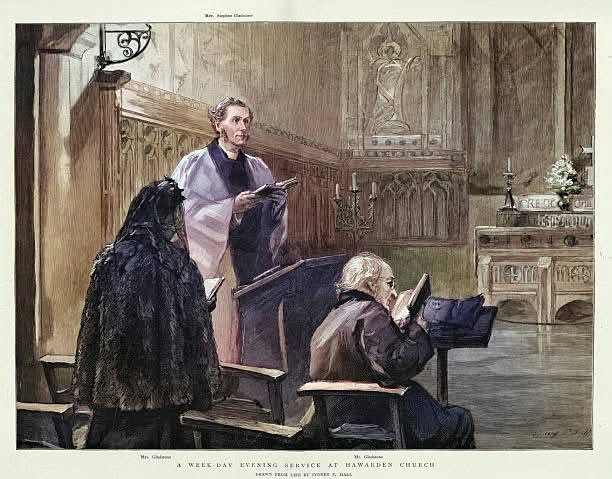
William Ewart Gladstone and his wife, at Mass, Anglican vicar, Hawarden Church, Vintage illustration 1890s, 19th Century

What happened to Mattins and Evensong? I am meeting Anglicans who have never attended either service. Or, who have only attended the modern version (euphemistically called Morning Prayer with little connection to the traditional shape). The modern church (oh, how I hate that term) is so quick to jump to “saying Mass” with traditional prayer services being an afterthought.

And what happened to “priest and people” together praying? Active participation means we have laypeople doing clergy jobs, and clergy dominating laypeople in their vocation.

And what has happened to fasting?

modern spirituality

It is intrinsic to ascetical theology to adapt itself to the contemporary situation, yet it can only evolve out of a living tradition with roots in the past. We have now discovered, rather painfully, that a scholar cannot just sit down and compose a new liturgy; nor can another scholar sit down and write a modern spirituality. Both depend upon the worshipping community developing a tradition. That, by the grace of God, seems to be happening, but it needs a compatible ascetical theology to support, guide, and nurture it, and the only source of such a theology is the tradition itself: it is sometimes more progressive to look back a thousand years than to look forward three weeks.

English Spirituality, 13

Optina Pustyn

Which fictional world would be the most fun to vacation in?

This is not a fictional world but rather a world about which I have read.

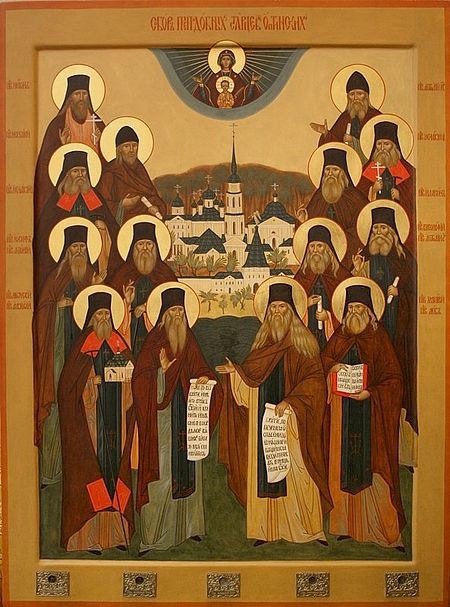
I would like to vacation in the Optina Pustyn (during the 19th century) – Russian religious community that is famous for its elders. It is everything about which I dream. And it is Russian (cf the last tsar). The above icon is in my book of icons.

I am not writing more but it would be so special I doubt very much I would ever leave. So maybe a permanent move?

Companion of New Skete

I am not a joiner! I did not join the “normal Anglo-Catholic” societies when I was a priest, nor any religious order as an oblate etc. But ….

It is intrinsic to ascetical theology to adapt itself to the contemporary situation, yet it can only evolve out of a living tradition with roots in the past.

English Spirituality, 13

I have been accepted as a Companion of the New Skete. And I am super excited. A connection to a living tradition while I remain within my own tradition. The beginning of a Prayer Book Ascetic.

the last tsar

If you could go back and witness any historical event, which one would you pick?

This changes every day but …

I would like to witness the last days of Tsar Nicholas II, especially the death of Rasputin. They are somewhat removed from each other but form a single event. If I could also see St Elisabeth the New Martyr that could really make the event.

Anyway …

salt to society

27. In the deserts of the old world, the first monks and nuns carried on the prophetic ministry of Israel in a renewed vigor. Thus, their lives bore witness to the essential Christian message before a civil and ecclesiastical world that often suffered from secularization, political intrigue, expediency, and a generally exaggerated and inhuman structuralism. They were thereby reminders to all that the Gospel was a way of life to be sought by all through the repentance that leads to the coming universal salvation.

28. Thus, monasticism must strive to keep this goal in mind, for it must be the salt of society; and for this reason if for no other, the monastery must be accessible to all, so that they may savor its life, its worship, and its message.

29. The fourth ecumenical Council of Chalcedon established canons for the inter-relationship of the monastery and the rest of the Church: nd the rest of the Church.

a. Though he may not interfere in the internal affairs of the monastery, the hierarch has the right to visitation, to impart the customary blessings when called for, and to ordain monks presented to him for orders. He should see to it that the integrity, purpose, and goal of the monastic life is preserved free of interference for the best interest the monks and nuns as well as the clergy and laity of the diocese in particular and the Church in general.

Monastic Typikon of the New Skete