The Decision
The president addresses the candidates directly, or through their parents, godparents and sponsors
We all wander far from God and lose our way:
Christ comes to find us and welcomes us home.
In baptism we respond to his call.Therefore I ask:
Do you turn away from sin?
I do.Do you reject evil?
I do.The candidates, together with their parents, godparents and sponsors, may turn at this point.
Do you turn to Christ as Saviour?
I do.Do you trust in him as Lord?
Common Worship – Baptism
I do.
Category: Anglican
nice picture
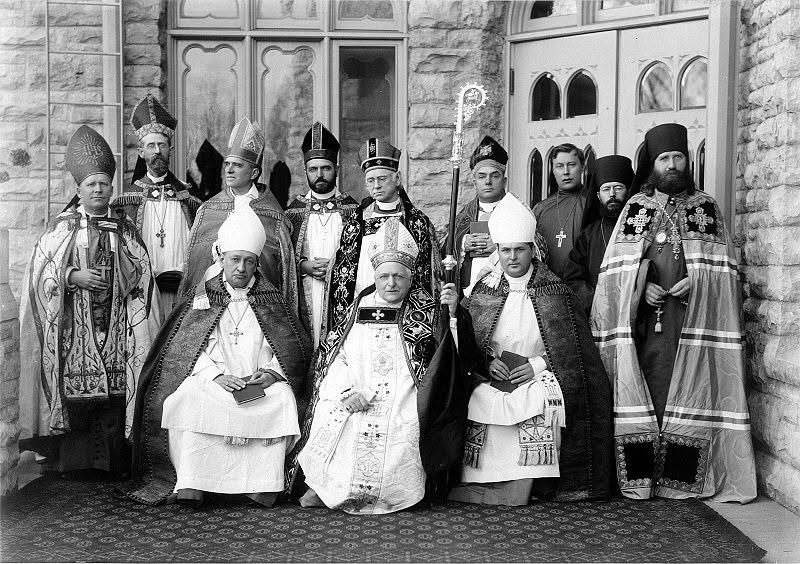
The consecration of Reginald Heber Weller as an Anglican bishop at the Cathedral of St. Paul the Apostle in the Protestant Episcopal Diocese of Fond du Lac.
Seated (left to right):
The Rt. Rev. Isaac Lea Nicholson, Episcopal Bishop of Milwaukee;
Rt. Rev. Charles Chapman Grafton, Episcopal Bishop of Fond du Lac;
Rt. Rev. Charles P. Anderson, Episcopal Bishop Coadjutor of Chicago.
Standing (left to right):
Rt. Rev. Anthony Kozłowski of the Polish National Catholic Church;
Rt. Rev. G. M. Williams, Episcopal Bishop of Marquette;
Rt. Rev. Reginald Weller,
Rt. Rev. Joseph M. Francis, Episcopal Bishop of Indianapolis,
Rt. Rev. William E. McLaren, Episcopal Bishop of Chicago;
Rt. Rev. Arthur L. Williams, Episcopal Bishop Coadjutor of Nebraska;
St. John Kochurov, Russian Orthodox protomartyr of the Bolshevik Revolution;
St. Sebastian (Dabovich),
St. Bishop Tikhon
Whitsun homily
The Lesson from the Holy Gospel according to John
AT that time: Jesus said unto his disciples: If ye love me, keep my commandments. And so on, and that which followeth.A Homily by St. Gregory
IT would be well, dearly beloved brethren, to make our comments brief as may be, so that we may di at greater length on the meaning whereon suddenly there came a t this great festival. For this is the d from heaven, and the Holy descended upon the disciples thereby changed the carnal mind men, filling them with love for hi self. Thus, whilst there appeared outwardly cloven tongues like as of fire, inwardly their hearts began to burn. At the same time that they perceived God in this fiery manifestation, they were all set on fire of love in its sweetness. The Holy Ghost himself is love. Whence it is than John saith: God is love. Whosoever then, desireth God with all his soul, the same hath already entered in possession of him whom he loveth. And except he possess him that he loveth, he cannot love God.BUT here consider this. It we to ask anyone of you whether he loveth God, he might perchance answer with all boldness and quietness of spirit: I do love him. But in this day’s Lesson, ye have heard what the Truth saith: If a man love me, he will keep my words. proof of love, therefore, is its manifestation in practice. Hence the same John hath said in his Epistle: The man that saith, I love God, and keepeth not his commandments, the same is a liar. For we do truly love God, and keep his commandments, if we deny ourselves the gratification of our appetites. Whoever abandoneth himself unlawfully desires, such an one plainly loveth not God, for thereby he setteth himself against God’s good pleasure.
NOTE the words: And my Father will love him, and we will come unto him, and make our abode with him. Think, dearly beloved brethren, what a dignity it is, to have God abiding as a guest in our hearts. Surely if some rich man, or some powerful friend, were to come into our house, we would hasten to have the whole house cleaned, lest perchance when he came in, he should see aught to displease his eye. So let him that would make ready his soul as an abode for God, cleanse it from all the filth of evil works. But consider once more what the Truth saith: We will come unto him, and make our abode with him. There a some hearts whereunto God cometh, but maketh not his abode therein. This is because they feel reverence for God when their conscience doth prick them; but in time a temptation they forget their conscience, and turn again to their sins, as though they bad never repented.
“Anglican” Religious Life
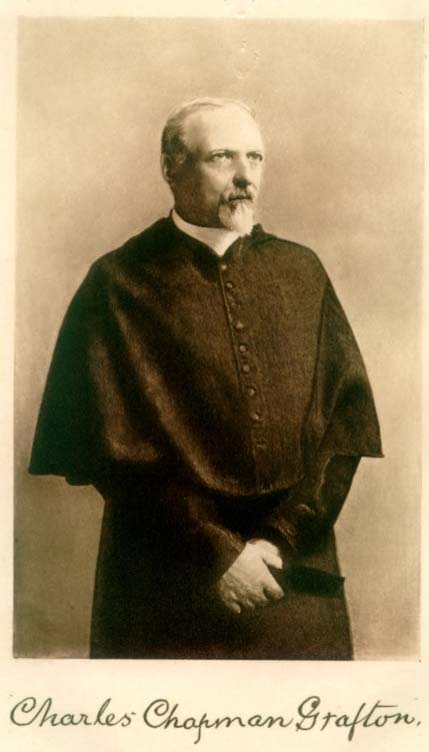
However, the general tone was of praise and support for Religious Life. The contribution which stands out, however, as one reads the debate a century later, came from Charles Grafton, Bishop of Fond du Lac in the USA, the only bishop present who had been a member of a community. He made three important points.
Petà Dunstan, Bishops and Religious 1897-1914
- First, he believed Religious Life was a vocation and should be treated as such.
- Second, it did not belong, as priesthood did, to the corporate life of the Church, but instead belonged ‘to the economy of the Holy Ghost’. Obedience to a Religious superior was a voluntary action of love, not the result of the legislative action of the Church. Unlike ‘the fixity of ministerial orders’ then, he believed the work of the Holy Ghost in the call of Religious Life manifested itself in a variety of different forms. Bishops had to trust this call to have a corrective power in itself.
- Third, he reminded the Conference that in Religious, bishops were dealing with ‘special devotional temperaments’ that could be ‘personally emotional’ about small matters of worship. A high-handed approach would not therefore be advisable. He went on to echo the arguments put forward in Father Puller’s paper, and concluded by suggesting bishops should regulate communities only in relation to property, financial donations and in insisting on communities ‘having sound government.
Fr Ignatius
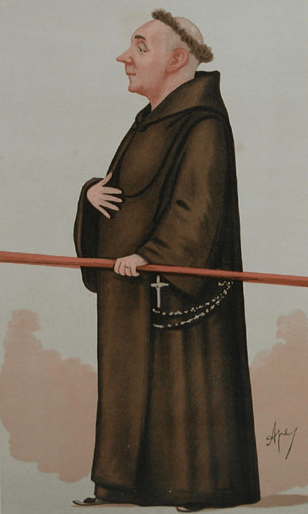
Joseph Leycester Lyne
- The restoration of the ascetic life and continual prayer in the Church of England;
- home mission work, by preaching, visiting the poor, and teaching the young;
- to afford a temporary religious retreat for the secular clergy;
- to raise the tone of devotion in the English Church to a higher standard by showing the real exemplification of the evangelical counsels;
- to aid in bringing about the union of Christendom.
King Charles I, passion-bearer
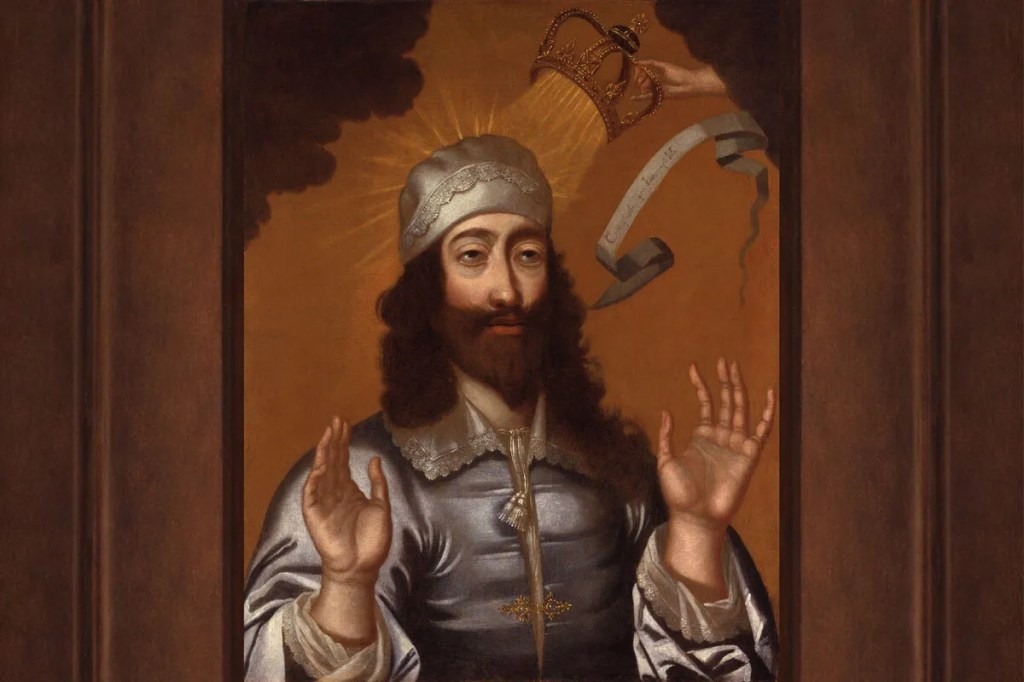
who is
Solitude is to be sought not because of the relief from those who are not there but for His sake who is
John Henry Newman
public & individual
The performance of the liturgy, which the Orthodox Church sees as the fundamental reason for its existence, is a public event in which the words and gestures of the priest, familiar to all, are repeated before the eyes of the faithful; any variation or deviation can be recognised. The deep spiritual truths of the Faith, on the other hand, were communicated to individuals by spiritual fathers who had prepared themselves through long periods of solitude and prayer.
France, Peter. Hermits: The Insights of Solitude
pilgrimage of grace

Why is the Pilgrimage of Grace not remembered liturgically? (Why is there no feast?)
One of the outcomes is:
Four of the seven sacraments that were omitted from the Ten Articles were restored in the Bishop’s Book of 1537, which marked the end of the drift of official doctrine towards Protestantism. The Bishop’s Book was followed by the Six Articles of 1539.
Also: the flag is the Five Wounds!!!!!
growth?
… he that prophesieth speaketh unto men to edification, and exhortation, and comfort. … the church may receive edifying.
1 Cor 14:3, 5
Take heed that the persons, whom ye present unto us, be apt and meet, for their learning and godly conversation, to exercise their ministry duly, to the honour of God, and the edifying of his Church.
BCP: The Ordering of Priests
The Church and the priesthood are for growth in relationship with Jesus. It is not an institution concerned with itself. It is concerned with individuals. What happens when this individual “growth” is no longer the aim?

