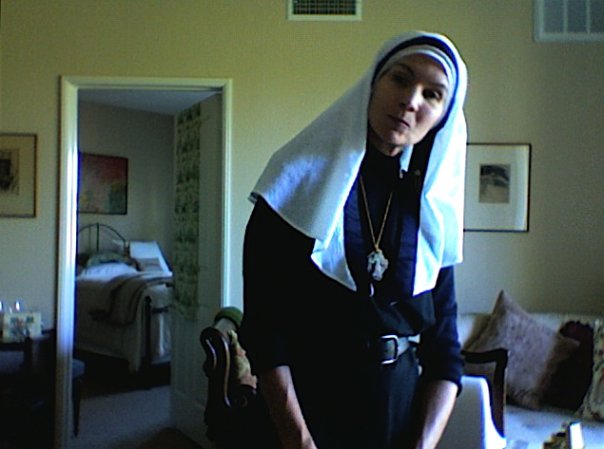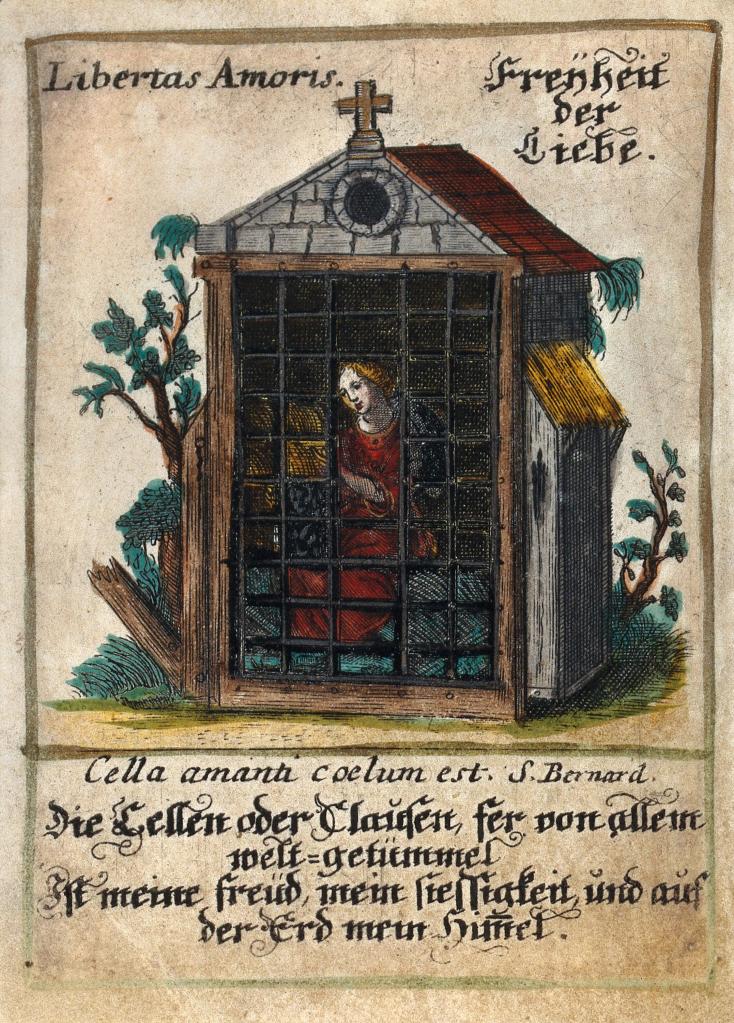
in cell

I wanted to share this post I found online: Anchoresses and Anchorites.

While it’s true that some lived alone in a single small room, some of them had multiple rooms, or even an entire house.  There are even examples of women living enclosed in groups of two or three.  Usually, but not always, this was because there weren’t enough spaces for women wanting to be anchoresses and having to join someone who was already enclosed.

Anchoresses were not left on their own.  There was always some church official keeping an eye on them.  They also received a lot of visitors, frequently pilgrims, most of them seeking advice.  Many anchoresses also lived in cells attached to churches and some of them weren’t restricted just to their cell, but to the church building as a whole.

The article makes an interesting point about the use of “anchoress”.

me?

Bill Goldberg

One of the issues I have struggled with most of my life is “who is this ‘me’?”. I tried (for many years) to take clues from culture, religion, and family. That just caused depression and anxiety. Here is one example:

The person on the right is Bill Goldberg – sometime NFL player, sometime WCW and WWE wrestler. I used to have a toy of him on my desk. It was the running joke that I have the complete opposite of me on my desk to inspire me – he is everything I am not. And I think I really brought into that view. I have always wanted to change “me” and this was the model that was placed before me. And, of course, a model I could never live up to!

It is very hard to escape the cultural and religious models forced on us from the outside. “This is what a man is!” I looked for models that I could live with but they are still “outside” of me. All of which is an escape from personal responsibility into the “crowd”. (Yes, an SK reference!) I am never ever going to look like Bill Goldberg – and neither do I really want to. I am always going to be awkward and a little (!!) on the weird side of life. I often really feel that weirdness – not in a good sense. Is that wrong? No! But I have to stop listening to the voices from outside that call it wrong. I have a choice to listen.

regnum mundi

I have rejected the kingdom of the world and all worldly adornment for the love of my Lord Jesus Christ; whom I have seen, whom I have loved, in whom I have believed, and whom I have adored.

Regnum mundi

BTW: They are some serious candles!

paradox of faith

I have been reading Fear and Trembling more. I am surprised (pleasantly) by the repeating of the phrase “paradox of faith” by SK. Ultimately for SK the issue is a question of right ordered relationship. Maybe in Augustinian terms, order love vs disordered love? For SK, the single individual stands before God alone without appeal to the universal (morality). The single individual’s relationship with God is absolute – there is nothing above it, nothing that defines it in terms of action.

So here is a quote:

The paradox of faith then is this, that the single individual is higher than the universal, that the single individual, to recall a now rather rare theological distinction, determines his relation to the universal by his relation to the absolute, not his relation to the absolute by his relation to the universal.

Fear and Trembling

Not by doing the right thing does one become a follower of Jesus but a follower of Jesus does the right thing. And that is the paradox of faith – to live in the tension of absolute relationship.

knight of faith

One of the books I often return to reading is SK’s Fear and Trembling. The first time I read it, like most of SK’s writings, it was confusing and seemed very repetitive. But on reflection, I think it has some great insights – also like most of SK’s writings.

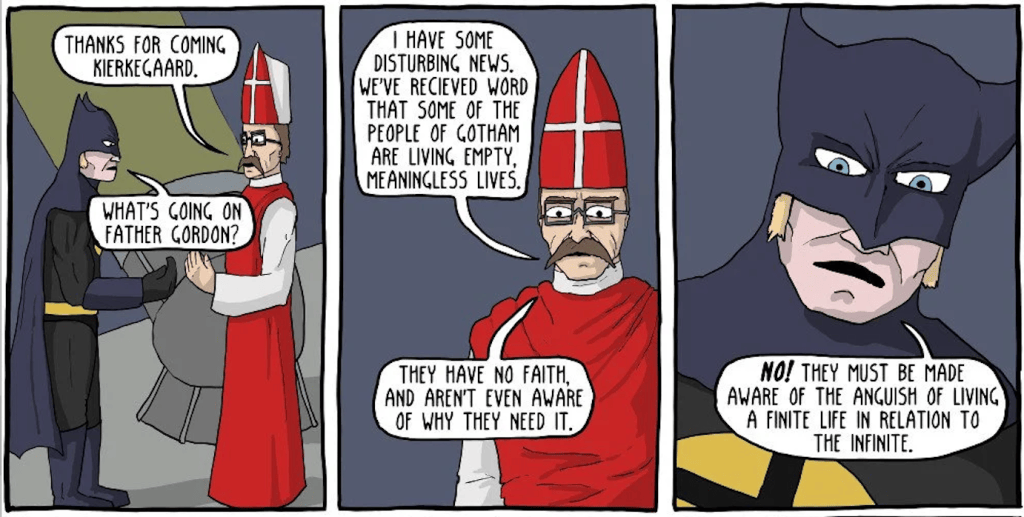
One I have been thinking about is the Knight of Faith – especially the relationship between the Knight of Faith and the knight of infinite resignation. Or, to put it differently, the “double movement” of faith of surrender followed by “receiving”.

Many people get to Lent and wonder what they should “give up”. Few ask, “what should I open myself to receive?”

I have been thinking about that double movement in the context of religious life – a life of faith. People see the singleness, the “enclosure”, and the rules. “I could not give all that up”, many people think. What they do not see is the ”me”, the space, and the freedom that is received. And the person who returns into the world in Jesus’ secret service.

Anyway, enjoy the comic strip!

things

I wrote this a couple of days ago. I have not had the energy to publish – I have struggled to get out of bed for the last two days. Now I have a headache (again) and feel completely overwhelmed! I have done the things I need to for today but I have not said the Office. But I wanted to publish something today.

I was reflecting on this past week and what it has meant for me.

Sunday I preached. I would very much like to do more, but that is beyond my control. Somehow it is part of my vocation. How that will work out I am not sure?! In one sense it is the “future” for me which is not clear at the moment.

But there is always the past. I need to get control in the sense that I need to get it straight in my head and heart. I have had some battles to fight, which I hope are over, and so I can get back to the heartbreak. The past has this incredible pull on my life.

I feel overwhelmed. I have gone back a year. I feel stuck.

the paradox of the solitary

Thus the position of the monastic recluse had developed into a far more socially symbolic and responsible one: on the one hand he was now locked up within a cell deep within the monastery itself in order to concentrate wholly on God; on the other, the local community had access to that cell in order to receive his advice, counselling and accumulated wisdom.

It reminds me of the Kierkegaard quote:

Of this there is no doubt, our age and Protestantism in general may need the monastery again, or wish it were there. The “monastery” is an essential dialectical element in Christianity. We therefore need it out there like a navigation buoy at sea in order to see where we are, even though I myself would not enter it. But if there really is true Christianity in every generation, there must also be individuals who have this need . . .

10 facts

I found this very interesting article: Anchoresses: 10 facts about the Life of Solitude. Written by the same author as the novel The Anchoress. (Alright, not super happy about the term anchoress but the article is good.)

In the Middle Ages, anchoresses were usually sealed in a cell adjoining the village church to ensure that she remained safe, and so that she could hear Mass and receive the Eucharist. An anchoress freely chose to be confined in a cell so that she could pray and read, committing her life to God. Men could become anchorites similarly enclosed in a cell, but their life was not always as restricted as that of an anchoress. In some cases they could leave to travel, and some were priests who chose to be enclosed, but would leave their cell to celebrate Mass in the church.

Interesting stuff!