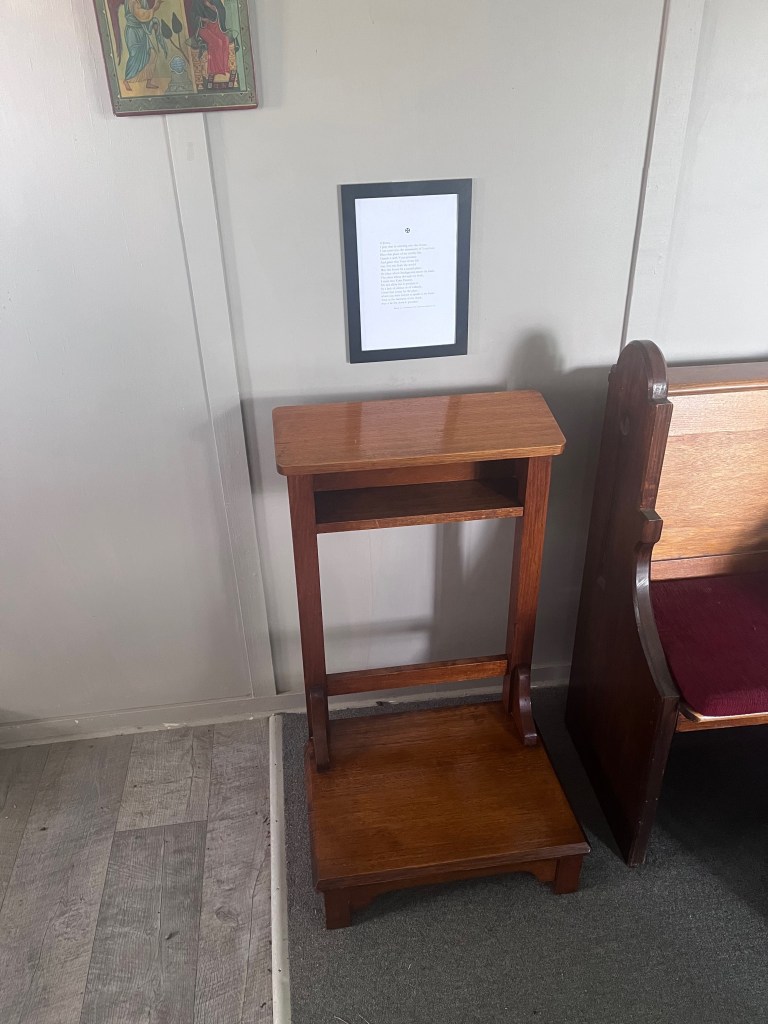
… on entering

O Jesus, I pray that in entering into this house
I can enter into the immensity of Your love.
Bless this place of my earthly life.
Enrich it with Your presence.
And grant that Your divine life
may free me from the world.
May this house be a sacred place:
the place where Bridegroom meets the bride.
The place where through my body,
I enter into Your Passion.
Do not allow me to profane it
by a lack of silence or of solitude.
Grant that it may be the place
where you have led me to speak to my heart.
And, at the moment of my death,
may it be the door to paradise.

Based on A Carthusian Nun’s prayer on entering her cell

Carthusians have, in their cell, an entrance area. This area has an altar and a kneeler. I like that idea. So the above is a prayer upon entering the Anchorage upon return from a journey (ie when I leave the enclosure).

… go worth

I had to speak to someone today about worldly affairs. Like anchorites of old, I am paying my own way. The whole conversation stressed me because it is so much outside of my experience of daily life. And I reflect on the following:

I have been thinking about enclosure rites (as one does). These, in the broader English tradition, normally include the Office of the Dead and a Requiem after the enclosure of the individual. In a somewhat strange twist, the enclosed individual gets to watch their own funeral through the squint. I wonder what people would say about me? Also, the anchorite normally dug their own grave, by hand, in their cell. But, overall, undoable in a modern context!

But what about the above? It is part of APBA – Commendations of the Dying. I used it recently and understand it more in an existentialist sense: enclosure as death to the world. The solitary life is a place in the grey area – in relation to the church (often without definition) and to the world (separate from it).

So I have been listening to Elgar’s version and am moved.

… the passionate

There is only one proof for the truth of Xnty and it is quite rightly the passionate proof that results when the anxiety of sin and the troubled conscience compel a person to cross the thin line that sep[arates] despairing madness―and Xnty. There lies Xnty.

Kierkegaard’s Journals and Notebooks

How do I feel about Jesus? The first question in Baptism (and the renewal) is, Do you turn to Jesus?. Do I? What does that mean in my context?

… more vocation thoughts

So more thoughts on the idea of vocation.

I found (and, yes, I am very excited) an online copy of the 1976 Anglican Religious Communities: a directory of Principles and practice. The excursion on the solitary life makes the following point:

The existence of solitaries living geographically apart from society helps those living in society to realize the solitary dimension of their lives. In this way the solitary is a sign to the world, as well as to the Church. By virtue of its closeness to the material environment, the solitary life can help our present age to recover a more balanced relationship to the material world.

Directory of Religious Life, 1976

My thought: I am super far away from the ideal.

vocation?

Life has changed and I am wondering (again) about my vocation.

So this morning some thoughts:

First, I have to learn to not lose me in my vocation. I am not my vocation. My vocation unfolds the me that God loves (wills). A vocation unfolds from the inside out.

Second: My vocation is this place. To be anchored here. My vocation is to be here. To be enclosed. I do not prepare for a vocation outside. This place is my vocation.

Third: To over-control that is a mistake. The form would become the end.

Fourth: And wait! In uncertainty!

words …

Some words from the Glossary:

Contemplative

A Religious whose life is concentrated on prayer inside the monastery or convent rather than on social work or ministry outside the house. Some communities were founded with the specific intention of leading a contemplative lifestyle together. Others may have a single member or small group living such a vocation within a larger community oriented to outside work.

Enclosed

This term is applied to Religious who stay within a particular convent or monastery – the ‘enclosure’ – to pursue more effectively a life of prayer. They would usually only leave the enclosure for medical treatment or other exceptional reasons. This rule is intended to help the enclosed Religious be more easily protected from the distractions and attentions of the outside world.

to continue?

Every year I have the same question: renew this blog or not?

I have not posted a lot in the past year and, from a completely self-centered egotistical point of view, this blog has had relatively small views. Is there something to be said for continuing?

Maybe the answer needs to come from within and not from the outside: do I see a point to continue? Yes, I do! I like writing even if I do it sporadically. I journal in my private life but do not feel comfrotable moving that into the public sphere. So this blog fills an in-between space? I think I have little to say academically – a past dream that has been lost in the darkness of the past. I worry about criticism and all the negative space of the blogosphere. My journal allows me to put into words on a page what is going on inside and it helps me to manage that space. So this blog is the next step: putting my life into words for the outside world.

The solitary life, by its existentialist stance and choice, is a proclamation of a paradox – life is more than productivity. It is also a life of waiting. Maybe these are themes I need to explore this year? I would also like to think aloud about the contemplative life within Anglicanism – is it possible or desirable?

So you have me for another year!

productivity?

People often ask, “So what do you do?”. And the answer is, “Well, not a lot!”.

I have been thinking about the idea of being “productive”. It has become a virtue. Like “conforming”, the other modern virtue, it concerns objectivity. My value as an individual is measured by what I can objectively produce.

But this “producing” has little to do with life. Productivity is not about subsistence but surplus. Objectification makes me an object that can be defined and valued. Productivity makes me a means to an end for someone else.

So maybe the solitary life is about not being an object and not being productive. It is about a relationship with the Other that cannot be measured and is not judged by what it does. It is about a life that says, “I love you and expect nothing in return” – I love you for Love’s sake.

Anyway …

Jacob Wrestles at Peniel

22 The same night he got up and took his two wives, his two maids, and his eleven children, and crossed the ford of the Jabbok. 23 He took them and sent them across the stream, and likewise everything that he had. 24 Jacob was left alone; and a man wrestled with him until daybreak. 25 When the man saw that he did not prevail against Jacob, he struck him on the hip socket; and Jacob’s hip was put out of joint as he wrestled with him. 26 Then he said, ‘Let me go, for the day is breaking.’ But Jacob said, ‘I will not let you go, unless you bless me.’ 27 So he said to him, ‘What is your name?’ And he said, ‘Jacob.’ 28 Then the man said, ‘You shall no longer be called Jacob, but Israel, for you have striven with God and with humans, and have prevailed.’ 29 Then Jacob asked him, ‘Please tell me your name.’ But he said, ‘Why is it that you ask my name?’ And there he blessed him. 30 So Jacob called the place Peniel, saying, ‘For I have seen God face to face, and yet my life is preserved.’ 31 The sun rose upon him as he passed Penuel, limping because of his hip. 32 Therefore to this day the Israelites do not eat the thigh muscle that is on the hip socket, because he struck Jacob on the hip socket at the thigh muscle.

Genesis 32

So just some random thoughts:

  • Jacob is alone before … Maybe Jacob has to be alone to wrestle with God? Sometimes we need to be alone with God.
  • God changes Jacob’s name to Israel to indicate a vocation “for you have striven with God”. In baptism, God gives us a name (and a vocation), we just need to listen for it.
  • God blesses Israel after they wrestle.

I really like this passage as an illustration of the solitary life. Being alone for Jesus. Being called by name. Being blessed. (And, maybe, being a blessing.)

solitude

I have been thinking about the various words that describe solitary life. So I looked up solitude. And it has this to say about the positive effects of being alone:

Freedom is considered to be one of the benefits of solitude; the constraints of others will not have any effect on a person who is spending time in solitude, therefore giving the person more latitude in their actions. With increased freedom, a person’s choices are less likely to be affected by exchanges with others.

That sounds like a description of the monastic enclosure and of solitude in a religious sense. In the end, it is all about freedom.

This morning I was thinking about silence. In particular, how the modern mind sees silence in terms of what I do. It is easy to see solitude and silence in a mechanical way: the absence of people and noise. But, in the spiritual sense, one can be in solitude and still have contact with people: “less likely to be affected by exchanges with others”.

The end of both solitude and silence is greater freedom to be with Jesus. They are a means to an end, not an end in themselves.