Where are my memories when I am not using them?
And how do I know what to remember when?
Where are my memories when I am not using them?
And how do I know what to remember when?
… what cannot be forgotten is that truth for Christians is not just another object but a concrete person, Jesus of Nazareth. …
Skepticism, Relativism, and Religious Knowledge:
Skepticism arises from our desire to know without the self being transformed. Ironically skepticism is but the result of our anxious desire to secure certainty by being “at home in the world.”
A Kierkegaardian Perspective Informed by Wittgenstein’s Philosophy
In a world of action, what does the call of Jesus to “follow me” mean? In the world of instant, what does it mean that everything belongs to God?
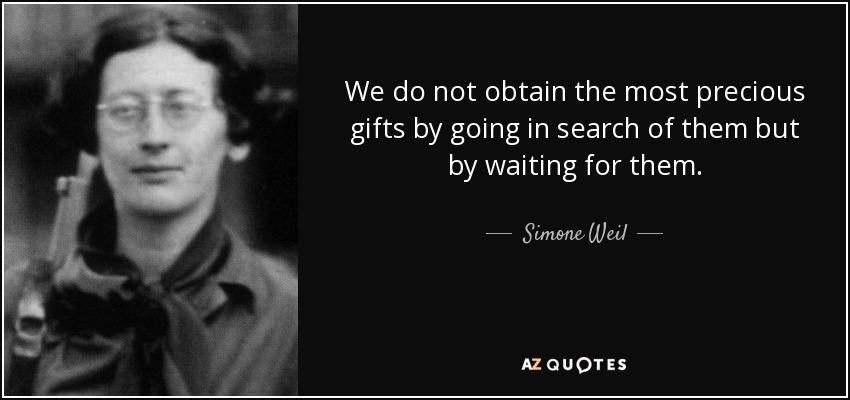
I like Weil – a rebel. She did not join the Church but confessed Jesus as Lord. Do moderns need to learn, from her, that waiting in hope is something to be desired?
Oh, that is not right ….
Me:

I am watching the X-Files. Yes, a little late but better than never.
One of the themes, of course, is the question of life outside of our understanding of “this world”. BTW: I am always amazed when aliens look like us!
Sully’s answer is normally something like, “That is outside of the laws of physics/science.” I wish she would add, “As we understand them.”
And that, for me, is the question: Are the laws of science/physics absolute and necessary? Or are these laws based on our small perspective, and could they be different in another context? In essence (see what I did there!), the question is. are these absolute within all contexts?
Perhaps it is a form of cultural narcissism to assume the experience of the world could not be different from my experience. And, maybe, to assume the laws of science apply to all contexts – even alien ones. And, worst of all, to assume that all aliens look like us. (Unless the alien is Species 8472.)
Anyway ….
Knowing whether or not man is free doesn’t interest me. I can experience only my own freedom.
Camus
We are born biological beings but we must become existential individuals by accepting responsibility for our actions. This is an application of Nietzsche’s advice to ‘become what you are’. Many people never do acknowledge such responsibility but rather flee their existential individuality into the comfort of the faceless crowd.
Flynn, Thomas.
Existentialism: A Very Short Introduction (Very Short Introductions)
No post – sorry. I have not spoken with anyone since the beginning of the year. So, maybe that helps?
I am reading. Lots of different books. I am trying for a book a week – non-theological and non-philosophical. I would like to read more literature. The first one is Never Let Me Go. A little slow at the start but gets a lot better. It has been banned in some states in the US.
Yesterday was a Desert Christian day. The following intrigues me:
We live in a society that is at once deeply individualist and deeply conformist; the desert fathers and mothers manage to be neither, and they suggest to us that the church’s calling likewise is to avoid both these pitfalls.
Williams, Rowan. Silence and Honey Cakes: The Wisdom of the Desert
The analysis is good. Yes, conformity is the only virtue. Perhaps it goes a little deeper:
Conformity is the tendency to change our perceptions, opinions, or behaviors in ways that are consistent with group norms. Norms are implicit, specific rules shared by a group of individuals on how they should behave. People may be susceptible to conform to group norms because they want to gain acceptance from their group.
Conformity
The modern tendency is to think, “If we can measure it, we can build it”. Perhaps Kierkegaard’s leveling?
Anyway, back to solitude and silence.
Day 6, and I think I am back to normal – whatever that may mean. I am unsure what I did yesterday – did I read or dance? Anyway, here is a thought for the day.
During this version of a COVID lockdown, I learned that I have an issue with “the church” as a whole and not individuals. Yes, that sounds like Kierkegaard and maybe he is the driving force in my thinking. And the problem is not the institution but rather the emphasis people place on the institution. The modern church has replaced the individual before God with a collection of congregational members called to follow a faceless organisation. There is no accountability to God for my actions but rather an urging to conform. In more philosophical terms, I wonder if the modern world, post-scientific revolution, is stuck in actuality. And the institution of the “church” is living without hope.
Anyway! Maybe a fever-induced hallucination?

Completely random question! The first thing that hits me is “believe”. What does it mean in this context? Perhaps I will leave that question for another post.
Absolutely. I think there is intelligent life outside of Earth. All the theological questions aside, why would God only create humans here? And, to paraphrase Bill & Ted, why would movies lie to us? An encounter would raise some interesting questions concerning our assumptions.
Anyway, do you believe in aliens?

