… temptation and scripture

Normally I do not comment on scripture readings – that is for the professionals to do. Yet, I was thinking about The Temptation of Jesus in the wilderness (Matthew 4:1-11) and how Jesus uses Scripture.

And my conclusion? Jesus uses Scripture to allow God to speak, and the devil uses Scripture to validate himself. The temptation is to use the holy for selfish means. The temptation is to not allow the holy to transform me.

Maybe a little simplistic (like me). Yet I find it a helpful way to think about how I use Scripture. Scripture does not exist in isolation from the hearer. Proof texting without context ignores the reader.

Anyway …

… today, yesterday, right, and wrong

What we do today is ruled not by the past but by the adaptation of tradition to the needs of the present. History can only help us decide what the essentials of that tradition are, and the parameters of its adaption.

The Liturgy of the Hours in East and West, xv

I am reading Taft’s chapter on Egyptian monasticism and noticed that I marked this passage in the Introduction. The mindset that asks, “Why is what was right now wrong?”, is a temptation for me. Maybe even for others?

So two ways: the past is always right; the present is always right. Either way the word “Tradition” becomes a battle cry. Both miss that Tradition, like experience, can be used both as a verb and as a noun. It is a living Tradition, for me, that is important. (And, please, do not get me started on the Scripture vs Tradition debate!!!!)

Jesus speaks of the good scribe (Matthew 13). Words to think about.

Anyway …

hermits and solitaries

The Advisor Council publishes “A Handbook of the Religious Life” which is extremely helpful. In recent editions, there is an Appendix on hermits and solitaries.

The terms Hermit and Solitary are often used interchangeably but for the purposes of the Handbook, the term ‘hermit’ refers to a member of a Religious Community and the term ‘solitary’ refers to one who is not a Religious.

Appendix V

There is a long tradition that anchorites (modern solitaries) are semi-religious. The above gives a technical starting point. There are many consequences from the above short working definition. Maybe I will post about them?!

emotional clutter

Bloganuary writing prompt
Where can you reduce clutter in your life?

Yes, there is much physical clutter in my life. (I am reordering The Anchorage and so I have everything out on the floor in the parlor, ie the front room.)

But I think emotional clutter is what makes my life more difficult. Don’t get me wrong: I like my emotions! I like feeling things and it is what makes me “me”. Yet I have emotional rubbish that really should be surrendered to the bin.

Like? Attachment to ways of doing things that simply do not work anymore. Or to ways of being that are no longer me, or were never me. And, of course, emotional attachment to people who are no longer part of my life.

I do not want to become a robot. However, I want to focus my emotional energy on people and situations that are relevant to my current life. And I need to let go of people who have decided to no longer be a part of my life.

If only some emotions were like an ice cream wrapper that goes in the bin after use.

to continue?

Every year I have the same question: renew this blog or not?

I have not posted a lot in the past year and, from a completely self-centered egotistical point of view, this blog has had relatively small views. Is there something to be said for continuing?

Maybe the answer needs to come from within and not from the outside: do I see a point to continue? Yes, I do! I like writing even if I do it sporadically. I journal in my private life but do not feel comfrotable moving that into the public sphere. So this blog fills an in-between space? I think I have little to say academically – a past dream that has been lost in the darkness of the past. I worry about criticism and all the negative space of the blogosphere. My journal allows me to put into words on a page what is going on inside and it helps me to manage that space. So this blog is the next step: putting my life into words for the outside world.

The solitary life, by its existentialist stance and choice, is a proclamation of a paradox – life is more than productivity. It is also a life of waiting. Maybe these are themes I need to explore this year? I would also like to think aloud about the contemplative life within Anglicanism – is it possible or desirable?

So you have me for another year!

feelings?

For most of my life, I have heard people say, “Feelings cannot be trusted”. And I must have said it a few times myself. I assume that feelings are subjective and therefore not trustworthy. But “reason” (whatever that may be) can be trusted because it is objective.

Why? Why can I not trust my feelings? Why can I not trust the subjective? In fact, why would I trust the objective? And is there such a thing as objective? Is reason always objective?

Why is only that trustworthy which is outside of me?

Maybe Boethius is to blame? Most likely it is me.

… as if …

[Hello to all the new subscribers – please comment where you are in the world (physically or existentially.)]

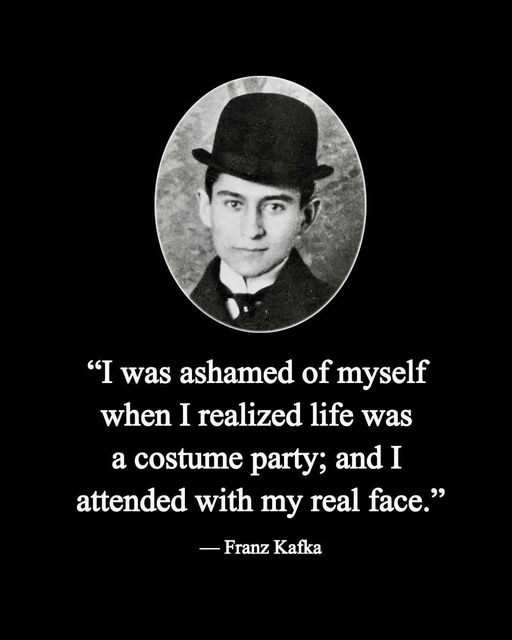
So I have been reading a lot about Kafka. (I have a thing for “Ks”.) While I see myself in him (and his writing), I am drawn to the idea of “reading Kafka” as something active rather than passive. The author through the text asks a question of the reader that only the reader can answer. There is no general key to finding meaning in the text. There is an “… as if …” to the text.

Anyway, here is a Kafka quote that really does speak for me: