openly in secret?

Yesterday’s sermon was about the Inbetween Times. It made me think of the monastic/religious life – a choice/vocation to inhabit the in-between times with purpose. And that made me think of this quote by the “the charismatic evangelical” Archbishop of Canterbury:

Life in Religion is the ultimate wager on the existence of God. The church should always be engaged in doing things that make no sense if God does not exist.

Most Revd Justin Welby, Archbishop of Canterbury

The above is written for the Anglican Religious Life Year Book so when it speaks of “life in religion” it is about monastic life. And the reason most forms of contemplative life are so unknowable to modern society is because it is the “ultimate wager” and “makes no sense” without God.

I have also been thinking that the absolute relationship to the absolute telos should be lived openly in secret. “Enclosed in plain sight”, for a modern anchorite. A complete commitment to Jesus who lives in my heart and I in his. But without the outward trappings of the monastic life – habit and a change of name.
Surrender to Jesus

Lord Jesus Christ,
I surrender today to you.

I give myself to you as a living sacrifice,
my soul and body,
my entire being.

I give to you all my thoughts, words and deeds,
all my sufferings and labours,
all my hopes and joys.
Above all, I give to you my heart
so that I may love only you
and be consumed in the fire of your love.

I place my trust in your infinite mercy.
I place within your hands all my cares and anxieties.
And I promise you my love and service.

Do with me what you will, my Jesus.
I desire only you.

Heart of Jesus, I surrender myself to you,
be my everything.

in freedom

… the self has the task of becoming itself in freedom.

Sickness unto death

So I am having this love affair with Sickness unto Death today. (Or should that be I am having a love affair with Kierkegaard?) So the above really spoke to me.

the goal?

The formula that describes the state of the self when despair is completely rooted out is this: in relating itself to itself and in willing to be itself, the self rests transparently in the power that established it.

Sickness unto Death

I am having a bizarre week emotionally. It started with a bump and bounced around a lot. It is living on the threshold. I admit I have used some of my “emergency medication”. It all feels like Indiana Jones running from the bolder at the start of Raiders. I have an overwhelming sense of doom.

So I have been reading some Kierkegaard – my go-to author in times of trouble. The Sickness unto Death has not been a book I have read a lot. But I was struck, reading it, by the above paragraph. Especially the final phrase, “the self rests transparently in the power that established it”. The balancing act of life is about openly resting in God. I think a case could be made of the religious life being about this “transparency”.

new and old?

The mandrakes give forth fragrance,
    and over our doors are all choice fruits,
new as well as old,
    which I have laid up for you, O my beloved.

Song of Songs 7:13

Jesus is proclaimed in new ways. Jesus is proclaimed in traditional ways. And sometimes, he is proclaimed by new old ways.

freedom?

A major theme in anchorite spirituality is freedom. Unlike more traditional monasticism, where the major theme is obedience, anchorites have the freedom to build their own spirituality alone. I think, in a way, this is how in a modern context, the ancient tradition can be lived. Built around prayer, meditation, and reading, the anchorite builds their life in freedom completely focused on Jesus.

So I found this quote from Merton that says it much better:

This means I must use my freedom in order to love, with full responsibility and authenticity, not merely receiving a form imposed on me by external forces, or forming my own life according to an approved social pattern, but directing my love to the personal reality of my brother, and embracing God’s will in its naked, often unpenetrable mystery. I cannot discover my “meaning” if I try to evade the dread which comes from first experiencing my meaninglessness!

Contemplative Prayer


surrender?

After Communion yesterday I had this very strong sense that Jesus is saying to me:

I surrender justice and “being right” for love of you.

I had a sense of being called to share in the cross in a special way. Psychologically I can see where that sense originated – I have decided on a new life. But Jesus gives up everything, including any concept of justice, on the cross for love of me.

Or, of course, it could simply be the leftover wine that I drank!?

Psalm 139:7

Refrain:    Search me out, O God, and know my heart.

1    O Lord, you have searched me out and known me;  ♦
you know my sitting down and my rising up;
you discern my thoughts from afar.
2    You mark out my journeys and my resting place  ♦
and are acquainted with all my ways.
3    For there is not a word on my tongue,  ♦
but you, O Lord, know it altogether.
4    You encompass me behind and before  ♦
and lay your hand upon me.
5    Such knowledge is too wonderful for me,  ♦
so high that I cannot attain it. [R]
6    Where can I go then from your spirit?  ♦
Or where can I flee from your presence?
7    If I climb up to heaven, you are there;  ♦
if I make the grave my bed, you are there also.
8    If I take the wings of the morning  ♦
and dwell in the uttermost parts of the sea,
9    Even there your hand shall lead me,  ♦
your right hand hold me fast.
10  If I say, ‘Surely the darkness will cover me  ♦
and the light around me turn to night,’
11  Even darkness is no darkness with you;
the night is as clear as the day;  ♦
darkness and light to you are both alike. [R]
12  For you yourself created my inmost parts;  ♦
you knit me together in my mother’s womb.
13  I thank you, for I am fearfully and wonderfully made;  ♦
marvellous are your works, my soul knows well.
14  My frame was not hidden from you,  ♦
when I was made in secret
and woven in the depths of the earth.
15  Your eyes beheld my form, as yet unfinished;  ♦
already in your book were all my members written,
16  As day by day they were fashioned  ♦
when as yet there was none of them.
17  How deep are your counsels to me, O God!  ♦
How great is the sum of them!
18  If I count them, they are more in number than the sand,  ♦
and at the end, I am still in your presence. [R]
19  O that you would slay the wicked, O God,  ♦
that the bloodthirsty might depart from me!
20  They speak against you with wicked intent;  ♦
your enemies take up your name for evil.
21  Do I not oppose those, O Lord, who oppose you?  ♦
Do I not abhor those who rise up against you?
22  I hate them with a perfect hatred;  ♦
they have become my own enemies also.
23  Search me out, O God, and know my heart;  ♦
try me and examine my thoughts.
24  See if there is any way of wickedness in me  ♦
and lead me in the way everlasting.
Refrain:    Search me out, O God, and know my heart.

Creator God,
may every breath we take be for your glory,
may every footstep show you as our way,
that, trusting in your presence in this world,
we may, beyond this life, still be with you
where you are alive and reign
for ever and ever.

Common Worship: Daily Prayer

Psalm 139:7b is the verse about anchorites!

singleness?

I very rarely discuss “church politics”. In fact, I have very little interest in it and find it somewhat confusing. It also makes me anxious and angry.

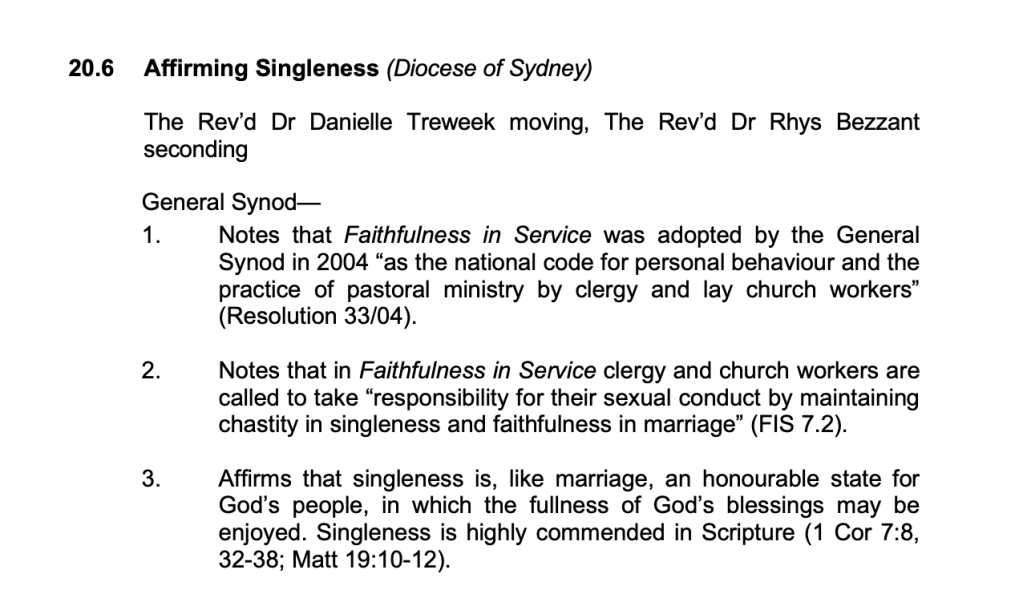
That being said, here is a motion to be discussed at the Anglican Church in Australia General Synod:

Of course, it is in a much wider context and really needs to be understood in that context. But I am somewhat pleased that singleness gets a mention. It is also interesting that it is seen as a state in the church rather than a negation.

Anyway, it is to be discussed today along with some other issues.